• home
  • index of films
    • index of films featuring maps
    • index of films featuring photography
    • bibliography
  • blogs
    • maps in films
    • choses vues - things seen
    • l'Escalographe
    • the BlowUp moment
  • how to map a film
    • the first maps >
      • Some Maps in Gance's Napoléon
  • Paris
    • 1890s-1909 >
      • firemen in Paris, 1896
      • La Villette c.1896-97
      • Hatot-Breteau 1897
      • Place de l'Opéra
      • Paris 1900
      • French Cancan >
        • the real Paquerette >
          • Paquerettes
      • Alice Guy - Paris locations >
        • Alice Guy in the brothel ...
      • a dangerous street corner
      • Capellani in Paris
      • La Fille du faux-monnayeur
    • 1910-1929 >
      • a gateway out of Paris c.1910
      • L'Enfant de Paris (narrative of an identification)
      • Fantomas Over Paris: episode 1 >
        • Fantomas Over Paris: episode 2 >
          • Fantomas Over Paris: episode 3 >
            • Fantomas Over Paris: episode 4 >
              • Fantomas Over Belgium
      • One Place, Three Films: Fantomas and the French New Wave
      • a staircase in Belleville
      • Vampires Over Paris >
        • Les Vampires 1
        • Les Vampires 2
        • Les Vampires 3
        • Les Vampires 4
        • Les Vampires 5
        • Les Vampires 6
        • Les Vampires, 7
        • Les Vampires 8
        • Les Vampires 9
        • Les Vampires 10
      • Irma Vep posts a letter
      • Inside-Outside: space and light in Judex
      • L'Affaire Barsac
      • neon Paris c.1913
      • electric nights in Paris (and Berlin)
    • 1930-1959 >
      • Quai des Orfèvres
      • Olivia - Audry - 1951
      • Paris Noir: Becker, Dassin, Melville
      • the persistence of graffiti: Paris c.1952
      • Du rififi chez les hommes - reading topotropically >
        • Du rififi chez les hommes - locations identified
      • Het Parijs van Le Ballon rouge
    • the New Wave and after >
      • New Wave places >
        • New Wave Paris >
          • New Wave Newness: architecture in Paris
          • Eric Rohmer in the rue de la Huchette, c.1956
          • Les 400 coups: Paris locations >
            • Baisers volés
          • 'New York Herald Tribune' - Parrish and Godard on the rue de Berri >
            • A bout de souffle (narrative of an identification)
          • the Grisbi connection: Chabrol and Becker
          • Les Bonnes Femmes: sequence by sequence
          • Une femme est une femme: the places documented
          • the boulevard des Italiens
          • Jules et Jim: Paris configured
          • the place of cinema: cinema as location in Vivre sa vie
          • Godard and Melville: the view from the rue Jenner >
            • Melville: more views from the rue Jenner
          • the New Wave in Pigalle c.1963
          • La Peau douce - displaced places
          • Le Bonheur 1965
          • Paris vu par
          • Masculin Féminin
          • The Topography of La Guerre est finie
        • France
      • Le Samourai: places and maps >
        • Un flic: art and artifice
      • Bresson in Paris - Pickpocket
      • Bresson 69-71
      • Every Revolution
      • statues in Godard and Duras
      • Holy Motors >
        • Holy Motors - notes
    • banlieues >
      • Le Canal de Ourcq
      • Ville d'Avray en 1903
      • Three filmmakers in Romainville
      • filmmaking in the Fontainebleau forest
      • Feuillade's lonely villas
      • anarchists in the suburbs c.1912
      • One Church Two Cemeteries: Clouzot and Chabrol at Montfort L'Amaury
      • Feuilladian Franju - Les Yeux sans visage
      • country houses and suburban villas
      • banlieue locations in L'Amour existe
      • the Landru Villa
      • 1 place 2 filmmakers: Rivette & Chabrol in Ermenonville
      • Céline et Julie: what's the address of that house?
      • cinemas in La Petite Voleuse
    • The Stairs: Paris
  • London
    • 1890s-1920s >
      • Lumiere London >
        • Lumière London, bis
      • Robert Paul in London: tour guide and film maker
      • Ultus in Isleworth
      • Cocaine 1922
      • Fu Manchu 1923
    • London Locations >
      • Piccadilly Circus >
        • Piccadilly Circus in films
        • Piccadilly Circus in art
        • Piccadilly Circus in postcards
        • Piccadilly Circus photographed
        • Piccadilly Circus: invisible things
      • Muswell Hill
      • the Arsenal Stadium mysteries
      • Brentford streets on screen
    • the locality of London studios >
      • Early Ealing
      • straight out of Whetstone
      • Walthamstow's studios
    • Sherlock Holmes >
      • some Baker Street irregularities
      • an American Sherlock in London
    • Sojourners + Cosmopolitans >
      • London in French Film >
        • Rififi in London
        • London in London River
      • maps in krimis
      • Kriminal (1966)
      • Kaurismaki's London c. 1989
    • places in Face
  • Geneva
    • Swiss New Wave - shared-world practice
    • Geneva in Swiss New Wave films >
      • SNW Geneva: collective housing
      • SNW Geneva: villas
      • SNW Geneva: bowlings + piscines
    • The Chronology of Le Petit Soldat
    • La Lune avec les dents (Michel Soutter 1966)
    • L'Inconnu de Shandigor (J.-L. Roy 1967)
  • signage, etc.
  • studios, etc.
    • Eclair
    • Eclipse
    • Gaumont >
      • Cité Elgé locations
    • Lumière
    • Lux
    • Pathé >
      • Where's Max >
        • when Harry met Max, and where
        • Max takes the train
      • Bébé victime d'une erreur...
      • Montreuil in Pathe films
      • Pathé police stations
      • Pathé filmmaking in Nice c. 1908
    • studios & the local >
      • Ealing >
        • Kind Hearts and Coronets: suburbia and other places
        • the view from Ealing
  • my local filmmaker
    • The Unfortunate Policeman >
      • Buy Your Own Cherries >
        • The Medium Exposed >
          • The ? Motorist >
            • The Fatal Hand >
              • A Little Bit of Cloth
              • Blind Man's Bluff >
                • Bill Sikes Up-To-Date
    • Walter Booth in Muswell Hill
  • my local cinemas
  • favourites
    • Agnès Varda >
      • Cleo 5-7 - Time
      • Sans toit ni loi >
        • Sans toit ni loi - the 12 tracking shots
        • Mona's postcard collection
    • Alice Guy >
      • Alice Guy + JLG
    • Chris Marker
    • Jacques Rivette >
      • a map of Out 1
      • Le Pont du Nord: locations identified >
        • topographical telescoping in Le Pont du Nord
        • Le Pont du Nord (narrative of an identification)
    • J.-L. Godard >
      • Godardiana
      • A bout de souffle: footnotes to the film >
        • A bout de souffle - the cast list
        • A bout de souffle in colour
      • photographs in Le Petit Soldat
      • Bande à part
      • Paintings in Pierrot le fou
      • sculptures in Made in USA
      • Les Fins de Godard
      • Week End - time, place and cars
      • Bukowski in Sauve qui peut (la vie)
      • Life magazine + Hdc
    • J.-P. Melville
    • Louis Feuillade
    • Max Linder
    • Robert Paul
  • cine-tourists
    • a German tourist in Paris: Le Silence de la mer
    • an American tourist in Paris
    • History Lessons in Rome
  • Nouvelle Vague
    • New Wave Christmas
    • the New Wave and modern art >
      • New Wave Braque
      • New Wave Chagall
      • New Wave Klee
      • New Wave Manet
      • New Wave Miro
      • New Wave Modigliani
      • New Wave Picasso
      • Pierre Alechinsky in Le Joli Mai (1963)
    • New Wave cameos
    • Attal et Zardi
    • Le Signe du Lion: six small things
    • New Wave films in New Wave films
    • Cahiers du Cinéma on screen
  • other things
    • assorted stamps
    • Maps in Books
    • the topographies of La Fille aux yeux d'or
    • place-time in Thérèse Raquin
    • photography >
      • 10 photographs by Brassaï in 3 Paris dancehalls >
        • painters in the rue Blomet
      • Gisèle Freund in Paris >
        • Gisèle Freund in Histoire(s) du cinéma
      • Godard's Histoire(s): photographs of women
      • the photographer as photographer: André Dino with Tati, Truffaut and Chabrol
      • some Simenon book covers
      • films playing at the Moulin Rouge
    • building sites >
      • a building site and some buildings, c.1961 >
        • Jean Ginsberg
      • 93 - Seine Saint Denis: HLM, cités, grands ensembles >
        • 93 - Seine Saint Denis: Aubervilliers to Bondy
        • 93 - Seine Saint Denis: Drancy to l'île Saint Denis
        • 93 - Seine Saint Denis: La Courneuve to Saint Ouen
        • 93 - Seine Saint Denis: Sevran to Villepinte
      • Chateau Gaillard
      • Euston Station
    • investigations >
      • A Remarkable Journey in Zigoto's New Motor-Car - 1912
      • the Hotel Bristol enigma
    • news >
      • French news
      • news from England
      • news from the U.S.
    • a picture of great significance
    • A Girl and a Gun >
      • Griffith, Shadowland, May 1922
  • efc - places
  • contact details
    • directories
    • address books
    • hotel registers
    • envelopes and postcards
    • telegrams
  • family, locality
    • a Succession of Edwards
    • Henri Grieshaber - architecte chaudefonnier
  • about this site
  • Publications
The Cine-Tourist
reading Balzac's La Fille aux yeux d'or, map in hand
Picture
Picture
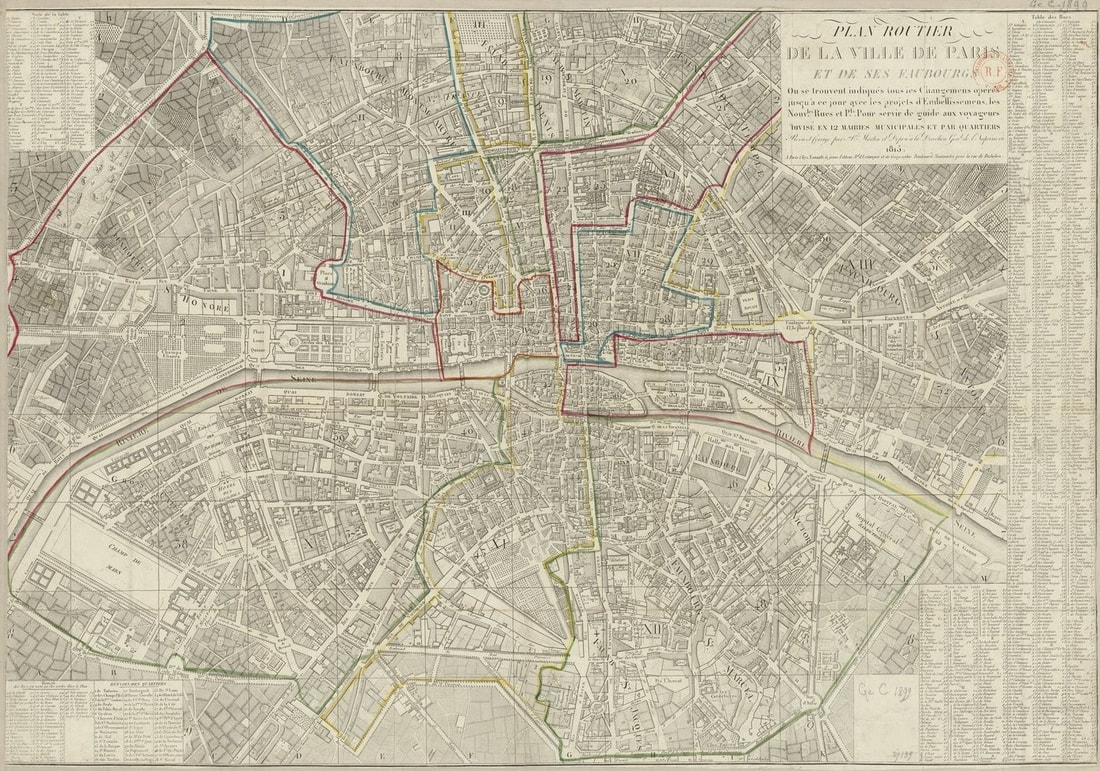
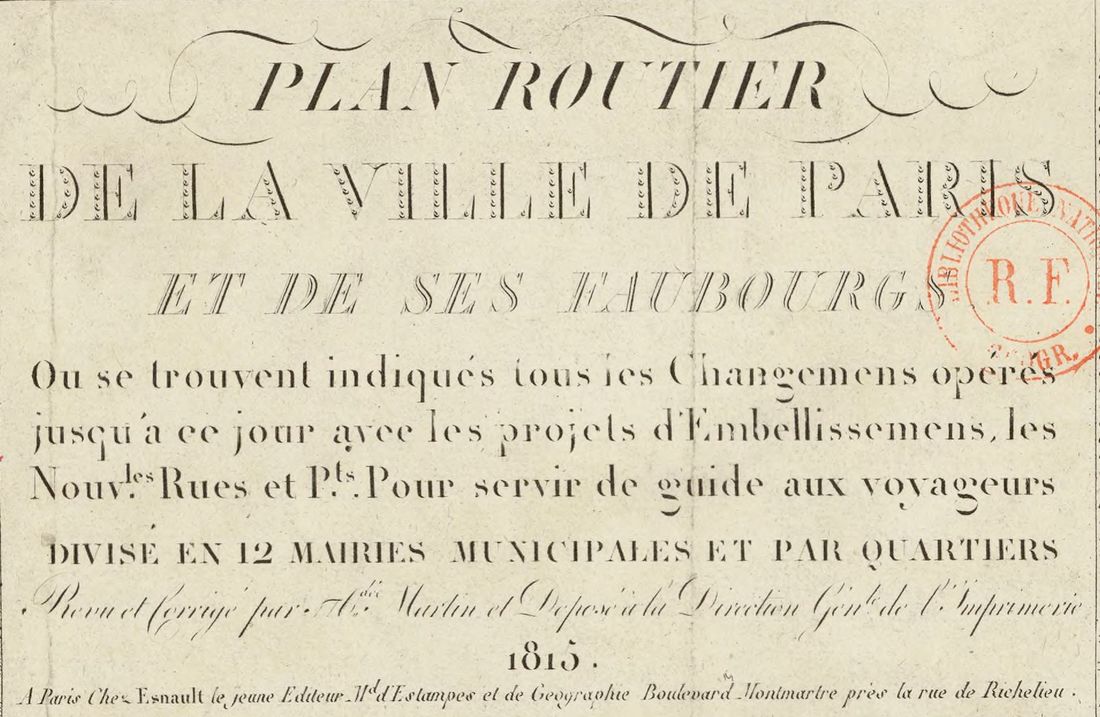
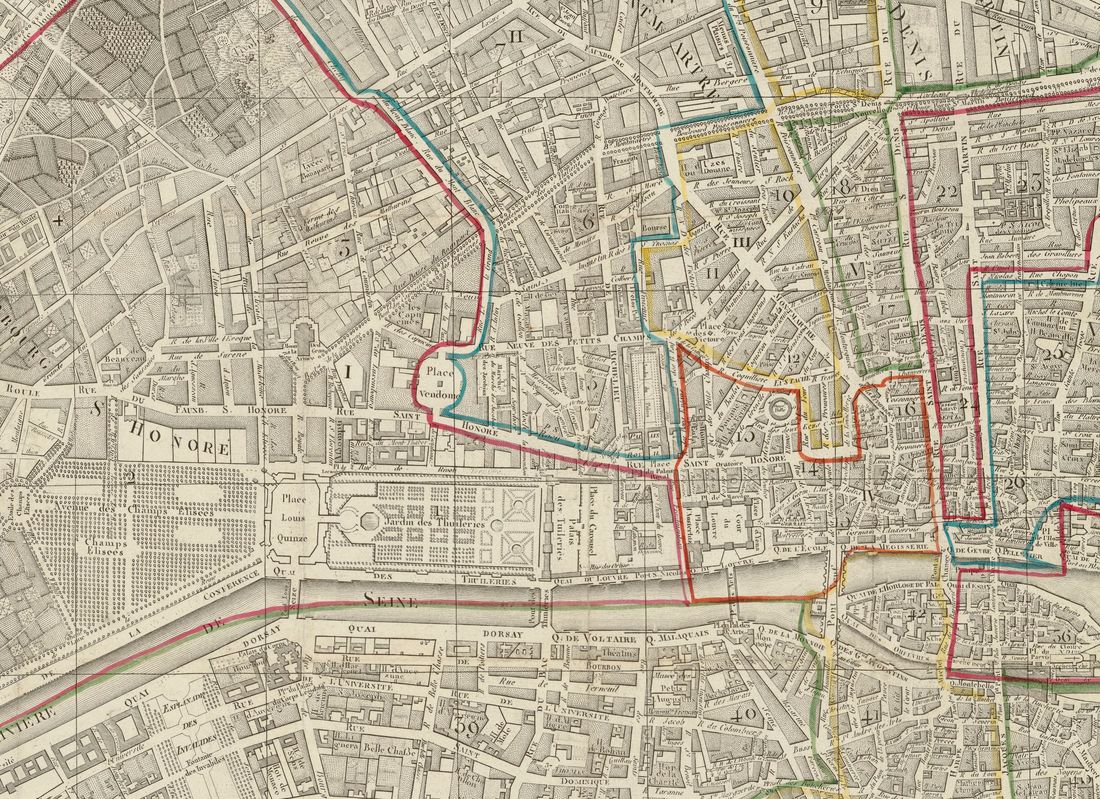
La Fille aux yeux d'or is set in April 1815, in the middle of the 'Hundred Days' of Napoleon's brief return to Paris and to power. The map above is from that year, but must date from before March or after June because the nomenclature is that of the Restoration in April 1814, when the Place de la Concorde became again the Place de Louis XV, the Quai Bonaparte became the Quai d'Orsay, the Rue Napoléon became the Rue de la Paix and the Rue Bonaparte became a blank on the map until a new name could be decided (by 1818 it had become the Rue Saint Germain des Prés). On this map the Lycée Impérial has become the Lycée Louis-le-Grand and the Lycée Napoléon is the Lycée Henri IV, but oddly the Lycée Bonaparte on the Rue Saint Lazare is not yet changed to the Lycée Bourbon (it would later become the Lycée Condorcet).
​
During the Cent-Jours the Place de Louis XV became the Place de la Concorde once again, briefly, but in La Fille aux yeux d'or it is referred to by its Ancien Régime name: 'En la suivant au bout de la terrasse, du côté de la place Louis XV, il aperçut le vieux marquis de San-Réal...'. When the narrator refers to the Rue de la Paix we could say that he is speaking in general terms in the present tense, so the use of that name would be justified, even if during the Cent-Jours the Rue de la Paix became again the Rue Napoléon. All of the other places named in the published text or in the manuscript are unaffected by changes of nomenclature: Tuileries, Rue Castiglione, Boulevard Montmartre, Boulevard des Italiens, Rue Montmartre, La Madeleine, Rue des Saussaies, Rue Saint-Lazare, Rue de la Pépinière, Rue Neuve des Mathurins, Rue de la Chaussée d'Antin, Rue des Trois Frères, Rue de l'Université. 
Picture
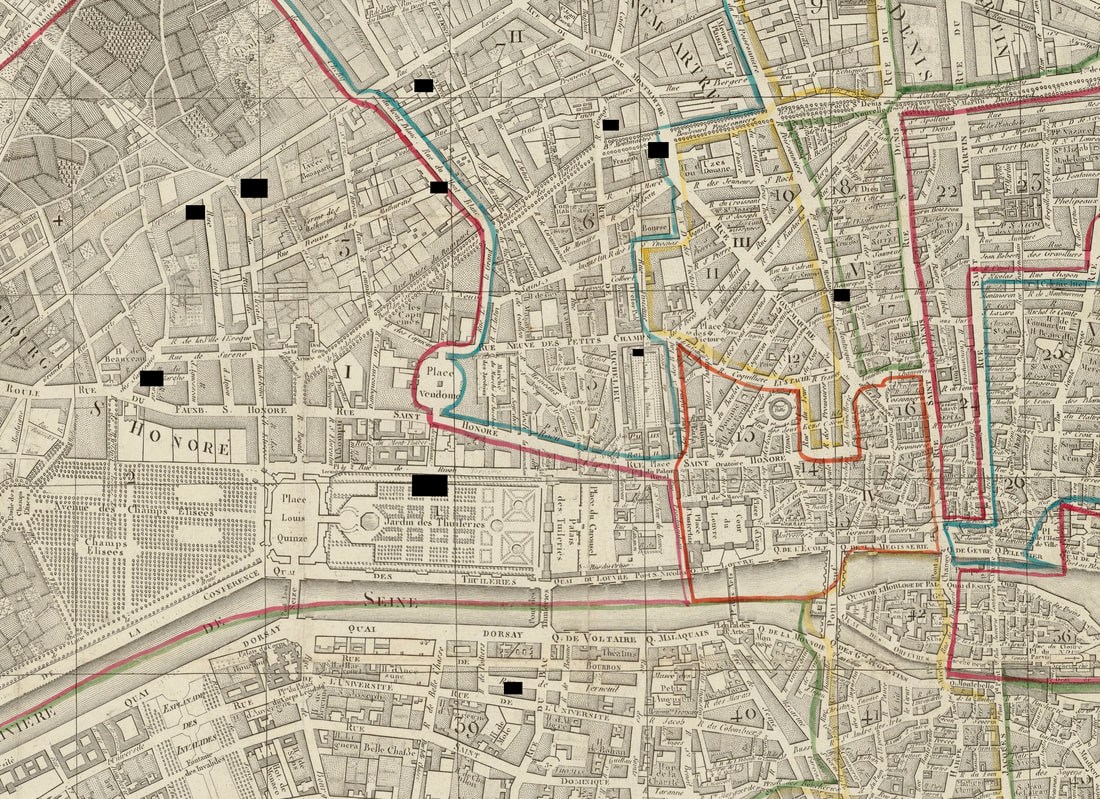
The locations of the novel are marked in black on the map above. With the exception of no. 54 Rue de l'Université, where Marsay lives,  all of the locations are rive droite​. The area of the action can seem restricted when compared to the area covered by the whole of the map (right), but this is a map of Paris and its faubourgs. Paris alone is not much bigger than the area covered in La Fille aux yeux d'or, the action of which which never ventures extra-muros.

Picture
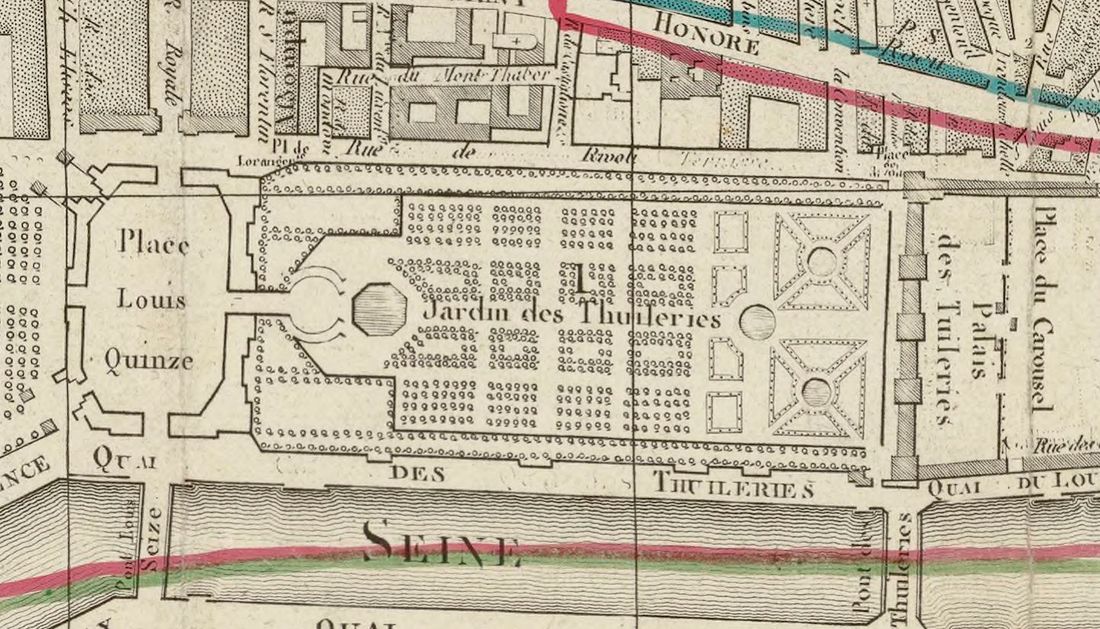
The first of the two major focal points of action is the Jardin des Tuileries, where the narrative events begin and end:
Picture
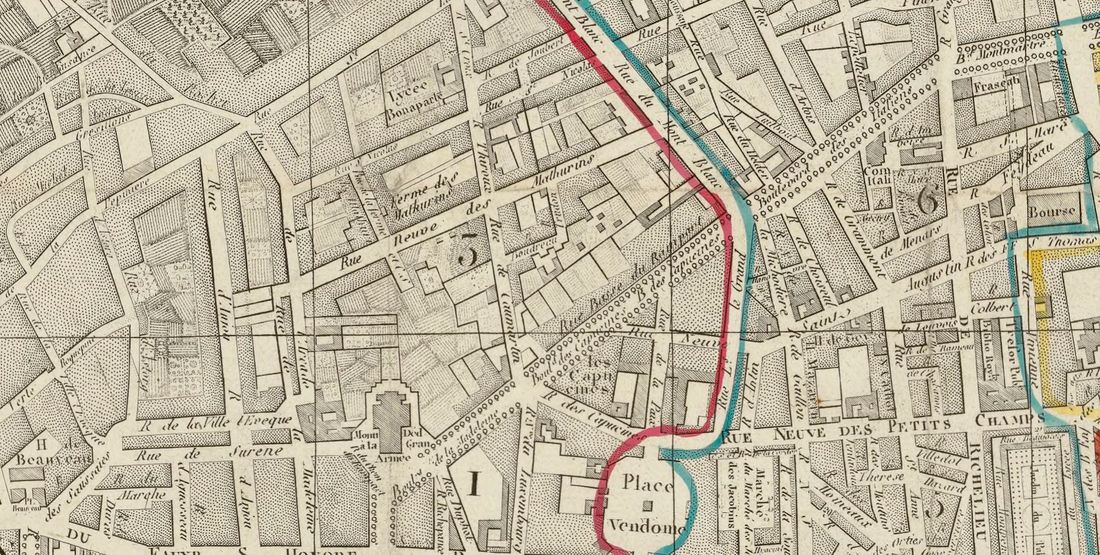
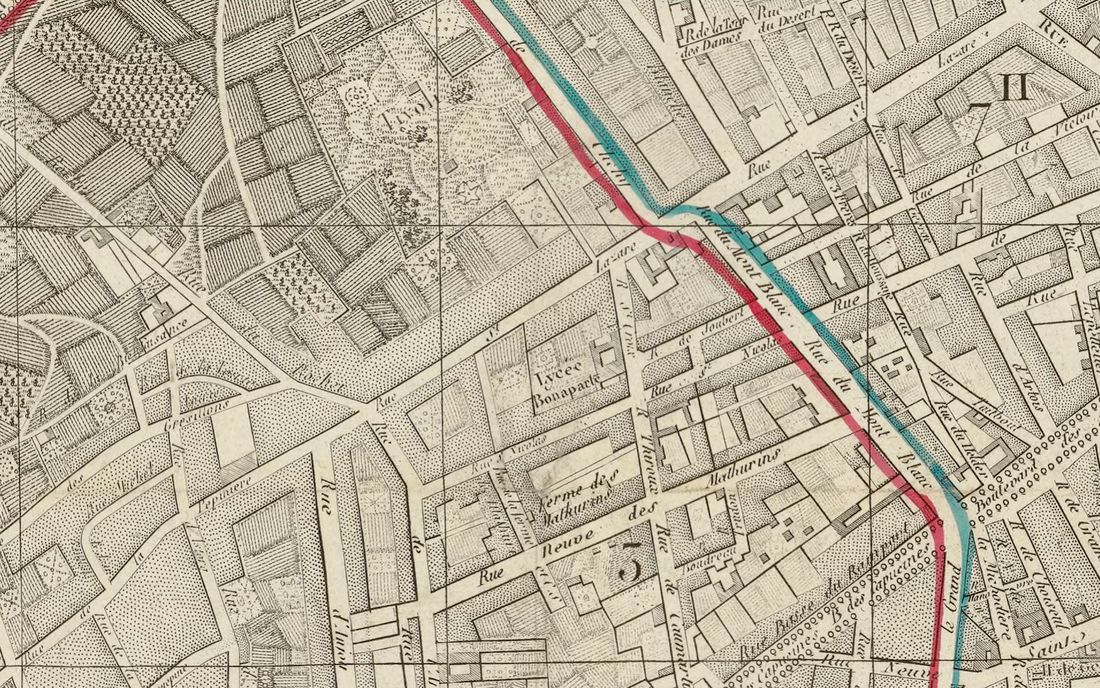
The second is the hôtel San-Réal on the Rue Saint Lazare, where Paquita lives and is killed. It isn't clear where on the Rue Saint-Lazare this is, but it is likely to be nearer the junction with the Rue de la Pépinière, which is where De Marsay's friend Paul de Manerville lives. Towards the other end is the Rue des Trois Frères, where the postman Moinot lives. Le Puits Sans Vin, the establishment at which Laurent meets Moinot to pump him for information, is at the junction of the Rue Neuve des Mathurins and the Rue de la Chaussée d'Antin, that section of which is still called the Rue du Mont-Blanc on this map:
Picture
De Marsay is collected from the Boulevard Montmartre near 'le café', which must mean Frascati's (in the manuscript the rendez-vous is near the Théâtre des Variétés). He is returned to the Boulevard des Italiens. Across the boulevard, opposite Frascati's, is the Salon des Etrangers, where De Marsay kills time before his third rendez-vous with Paquita:
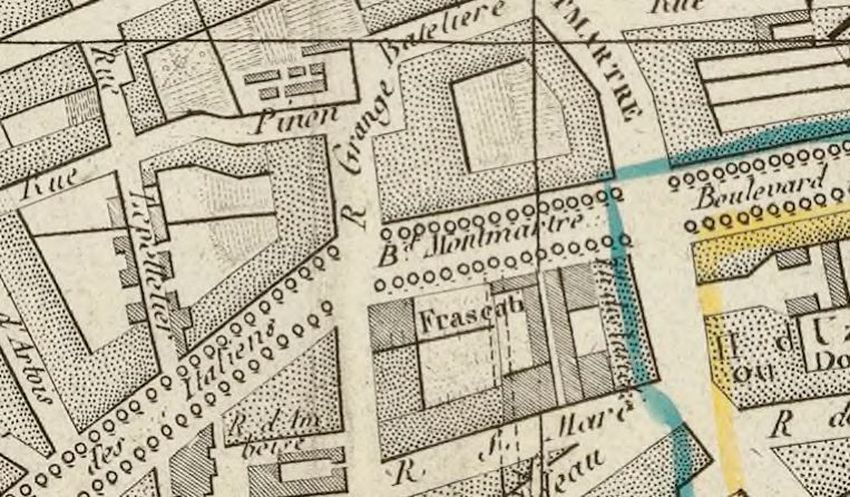
Picture
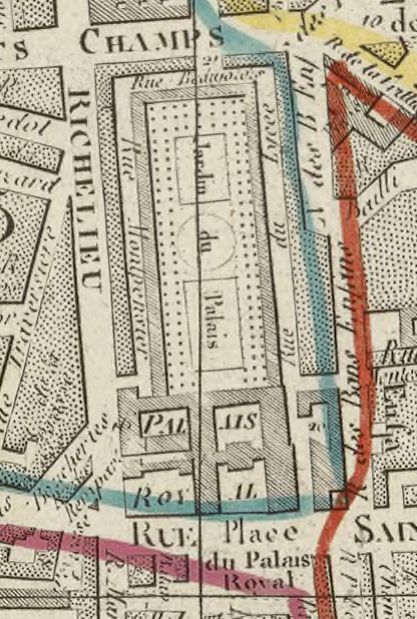
The night before his first rendez-vous he had dined and gambled at the Rocher de Cancale, on the Rue Montorgueil (below), and in the manuscript there is mention of a dinner with Paul de Manerville 'chez Véry', the restaurant on the Rue Beaujolais by the Palais-Royal (right) that is now the Grand Véfour.
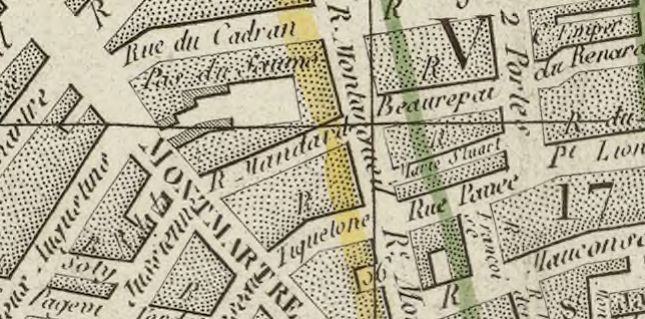
Picture
Picture
The first house to which De Marsay is brought to meet Paquita is unlocated in the final text but placed in the Rue des Saussaies in the manuscript. His journey there takes him 'along the boulevards to La Madeleine', from the top right-hand corner on the map below to the bottom left-hand corner:​
Picture
For the reader, finding these locations is simple enough: every named place in the published text or the manuscript is  matched with that place-name on a map. The text itself, however, describes elaborate efforts made by its characters to discover the place where Paquita is. Firstly, De Marsay follows Paquita in a cab to the house on Rue Saint-Lazare. His servant Laurent then learns from the postman the name of those who live in the house, including Paquita, and De Marsay is able by devious means to get a letter to her requesting a rendez-vous. The arrangement is made and De Marsay meets Paquita's servant on the Boulevard Montmartre. This first journey is the one we can trace on the map above, but De Marsay is so distracted by his thoughts that he is unable to work out where the carriage is going and he doesn't know 'where the vehicle stopped'.
​
For the journey to his second rendez-vous with Paquita De Marsay is required to wear a blindfold. This time, as 'a young man who knows his Paris', he hopes to be attentive to the details of the journey and work out his destination, but he is overcome by emotion and is unable to concentrate, so is again brought to an unknown place. The irony is that this different place is Paquita's home, the address of which he had  himself discovered days before when he followed her.

​For the journey to the third rendez-vous he is again blindfolded but this time he concentrates and is almosty certain that he has been brought to the house on the Rue Saint-Lazare. When he leaves, no effort is made to hide the fact that he had been at that address.

​A week or so later, when, with Ferragus and other confederates from the Thirteen, he comes there again to kill Paquita, he has brought a map of the house, but Ferragus declares that he has no need of a map to work out who is where in the house. 

Readers who need maps to find their way around Balzac's text are awed by such topographical acuity.