
Robert Paul (1869-1943) had at least four homes in the vicinity of where I live now. (See here for a list of addresses associated with him.) One was called 'Malvern', but is now 'Muswell Hill Food & Wine', the shop to which I go for last-minute, late-night supplies of wine and sundries. Paul was living there in 1903:
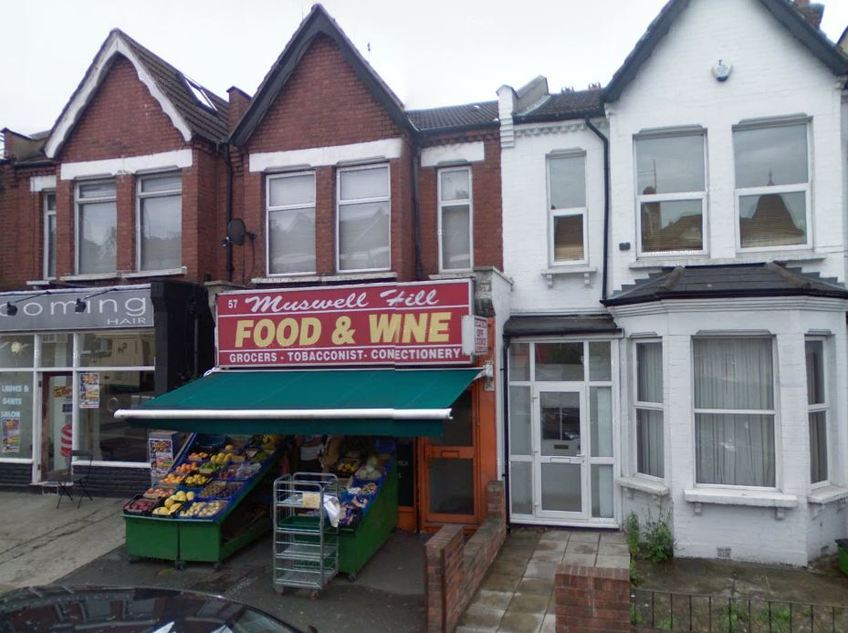
(Update 06.04.2013: this house has recently been in the news, see here.)
Another, further up Colney Hatch Lane, was called Beechencliff (the house next door to our family doctor). Paul was there between 1905 and 1908:
Another, further up Colney Hatch Lane, was called Beechencliff (the house next door to our family doctor). Paul was there between 1905 and 1908:
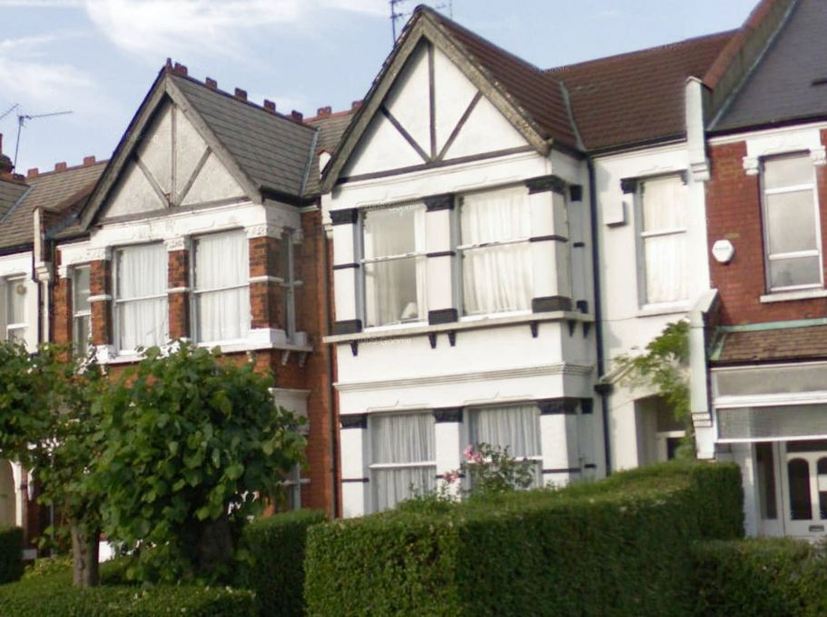
The last, called 'Newton', was a house he had built for himself on Sydney
Road:
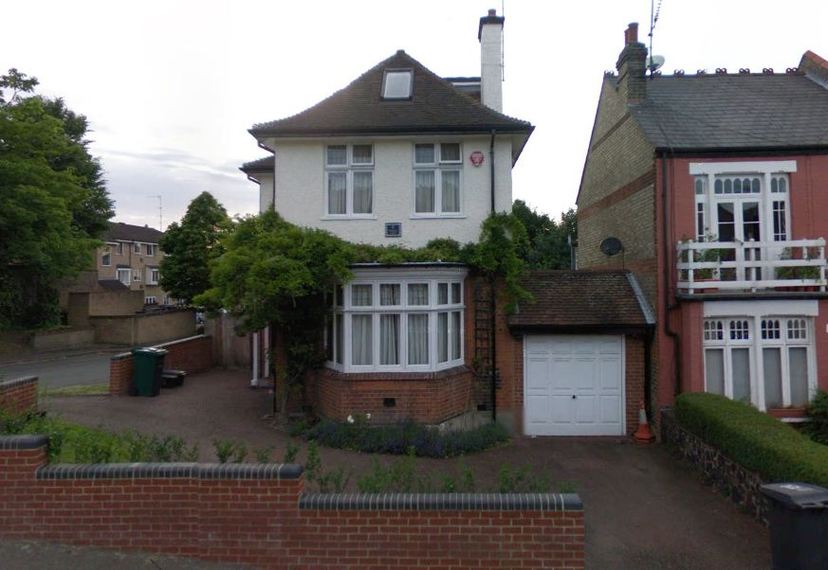
To this house is affixed a plaque commemorating his contribution to the establishment of cinema in England. Paradoxically, this house was built in 1914, four years after he had abandoned film production to devote himself exclusively to his first vocation, electrical engineering:
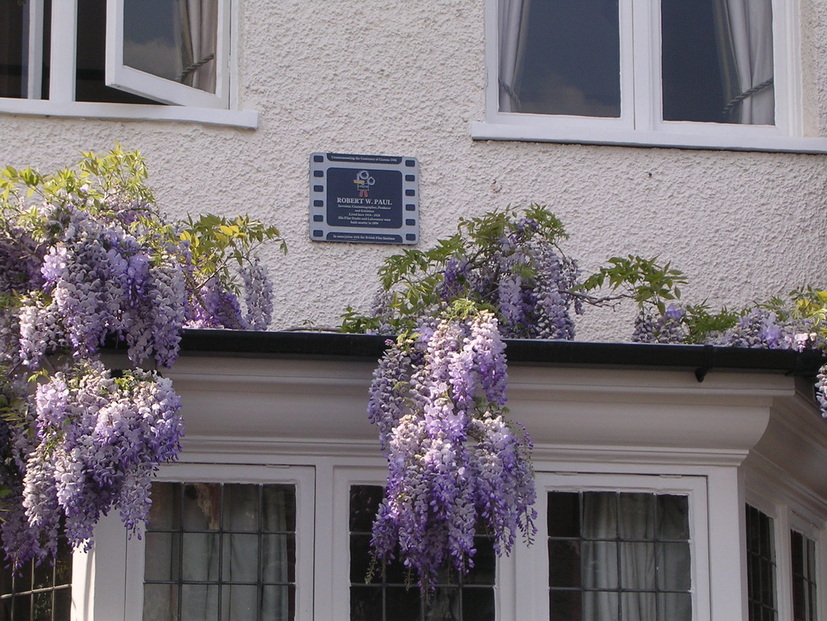
Paul came to live in this area to be near the film production facilities he had built on land to the east of Colney Hatch Lane, adjoining Sydney Road and Newton Avenue. (These facilities evolved into his engineering works, manufacturing electrical instruments, which passed into other hands but remained an important local employer until eventual closure in 1975.)
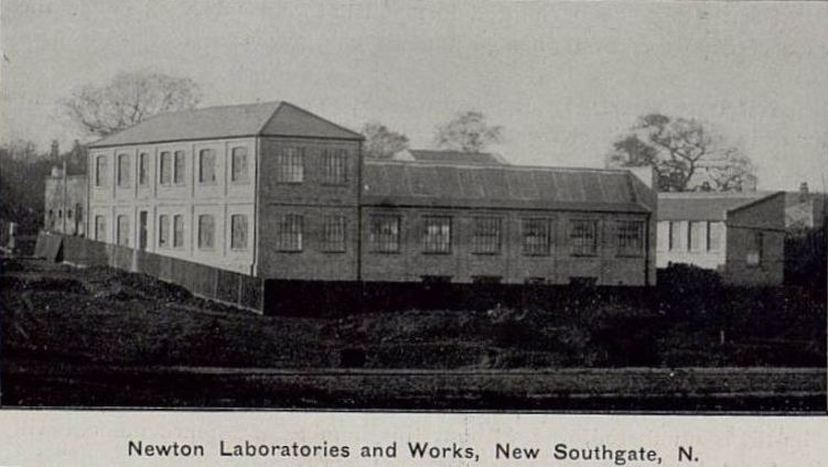
The 'Animatograph Works' included a studio, enabling the confection of imaginary spaces and places (through painted backgrounds, constructed scenery and cinematic trickery).
Paul’s studio, in which he produced such splendid fantasies as The Magic Sword (1901), may have distanced his filmmaking from the real world that he had been documenting (the 1896 Derby, the Queen’s Jubilee in 1897), but the premises were physically contiguous with a different real world, the ordinary streets of a burgeoning suburb. These are the streets that we find documented in seven of the extant films: An Extraordinary Cab Accident (1903); Buy Your Own Cherries (1904); Mr Pecksniff Fetches the Doctor (1904); The Unfortunate Policeman (1905); Is Spiritualism a Fraud? (1906); The ? Motorist (1906) and the recently rediscovered The Fatal Hand (1907).
Paul’s studio, in which he produced such splendid fantasies as The Magic Sword (1901), may have distanced his filmmaking from the real world that he had been documenting (the 1896 Derby, the Queen’s Jubilee in 1897), but the premises were physically contiguous with a different real world, the ordinary streets of a burgeoning suburb. These are the streets that we find documented in seven of the extant films: An Extraordinary Cab Accident (1903); Buy Your Own Cherries (1904); Mr Pecksniff Fetches the Doctor (1904); The Unfortunate Policeman (1905); Is Spiritualism a Fraud? (1906); The ? Motorist (1906) and the recently rediscovered The Fatal Hand (1907).
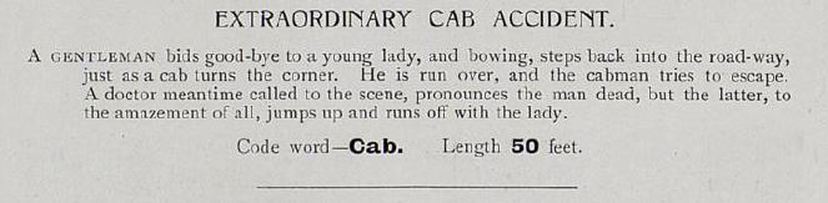
An Extraordinary Cab Accident is a seemingly simple film with just one camera set-up, but actually three shots, presenting a gag achieved through the substitution of a dummy for an actor (first cut) and then the substitution of the actor for the dummy (second cut). The gag is to show someone seemingly run over by a cab and pronounced dead by a passing doctor, but who then gets up and runs off as if it had been all a joke. The joke is in part metatextual, played on the film’s audience who believed that the man was dead because they had been fooled by the substitutive tricks. The other part of the joke is on the policeman, who ran to catch the fleeing cab driver and managed to bring back both driver and passenger, only to be pushed aside by the victim as he himself ran away, with his lady friend, watched by the doctor and the passenger, both laughing.
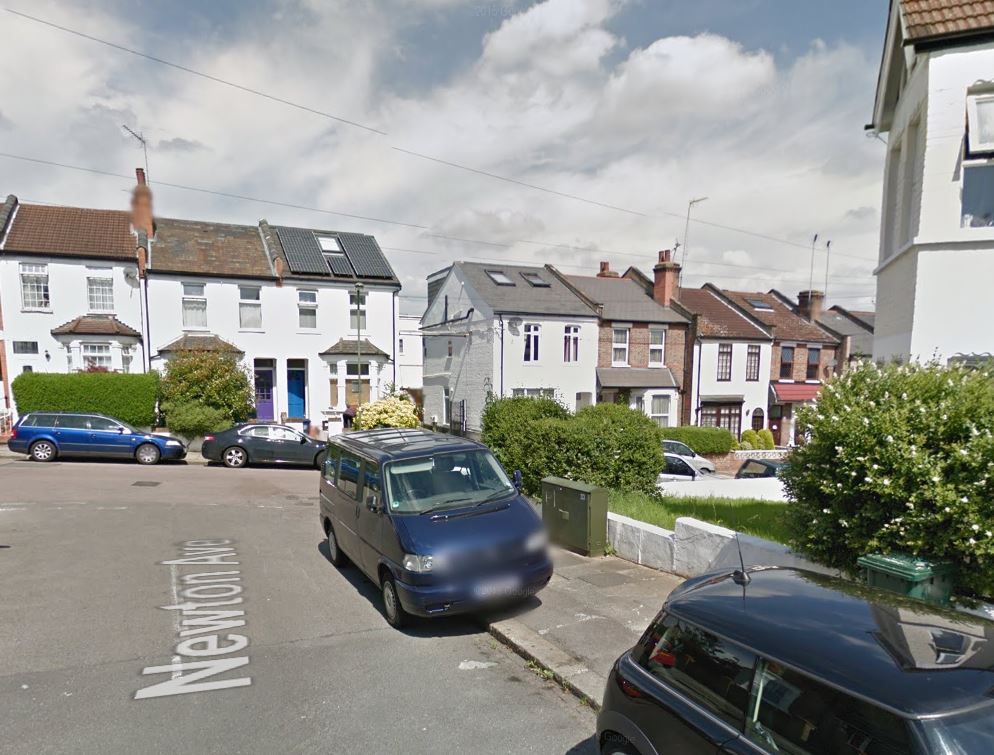
The camera is positioned on Newton Avenue, pointing towards the junction with Pembroke Road. The interest of this position is that it allows the fatal cab to come round a corner and surprise the accident victim as he insouciantly crosses the road (walking backwards). The topography is clearly delineated by passers-by along each street, and by the policeman positioning himself on the corner before it is turned by the cab.
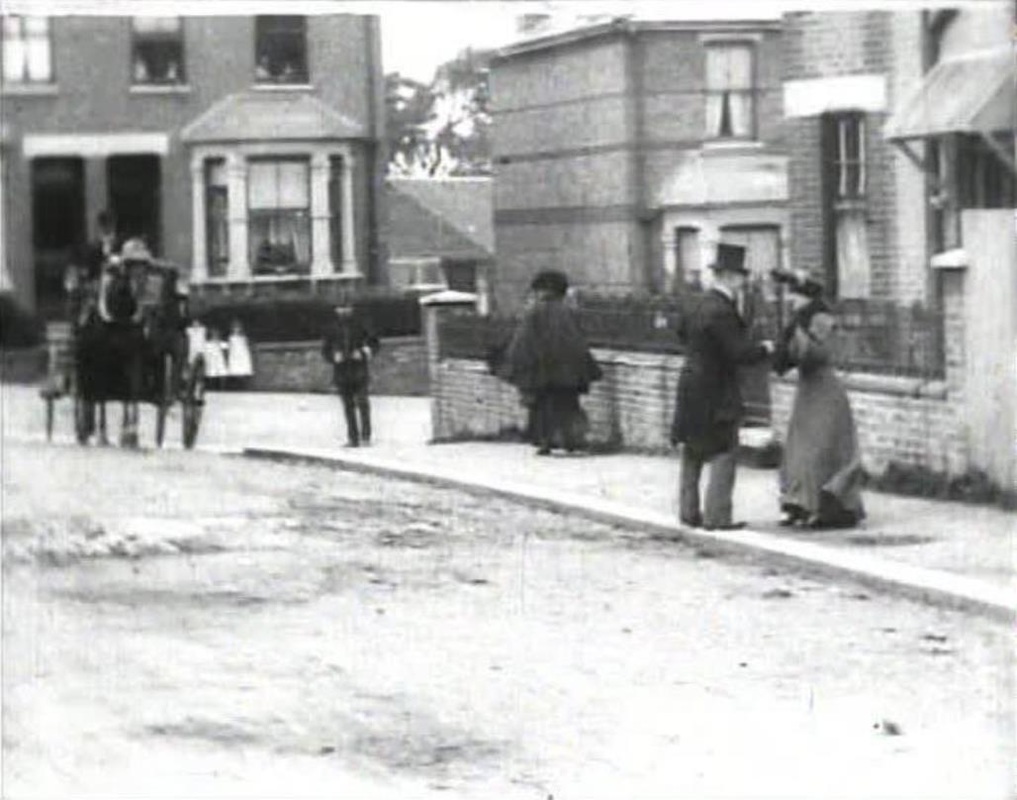
This particular camera position is of course chosen as a matter of pure convenience, a view of the nearest corner to the Newton Avenue Works, but the record of that aspect in Paul’s forty-nine-second film is a matter of interest to many locals now, for example: to the occupants of the three houses shown (139 and 141 Pembroke Road, 27 Newton Avenue); to the immediate neighbours, including those living in Cambridge Gardens, the houses built on the site of Paul’s Works; to those of us interested in the history of this less celebrated slope of Muswell Hill (including the notorious ‘Freehold’ around the lower reaches of Sydney Road, an insalubrious quarter accommodating the likes of those who had worked on or in two nearby grand projects, the Colney Hatch Asylum and the Alexandra Palace); to those writing the history of cinema in London; and to historians of cinema’s relation to place, particularly when the relation is to a place of such ordinariness.
The camera records the extraordinary accident, of course,
but of the ordinary things it records I would like to note three things.
One:
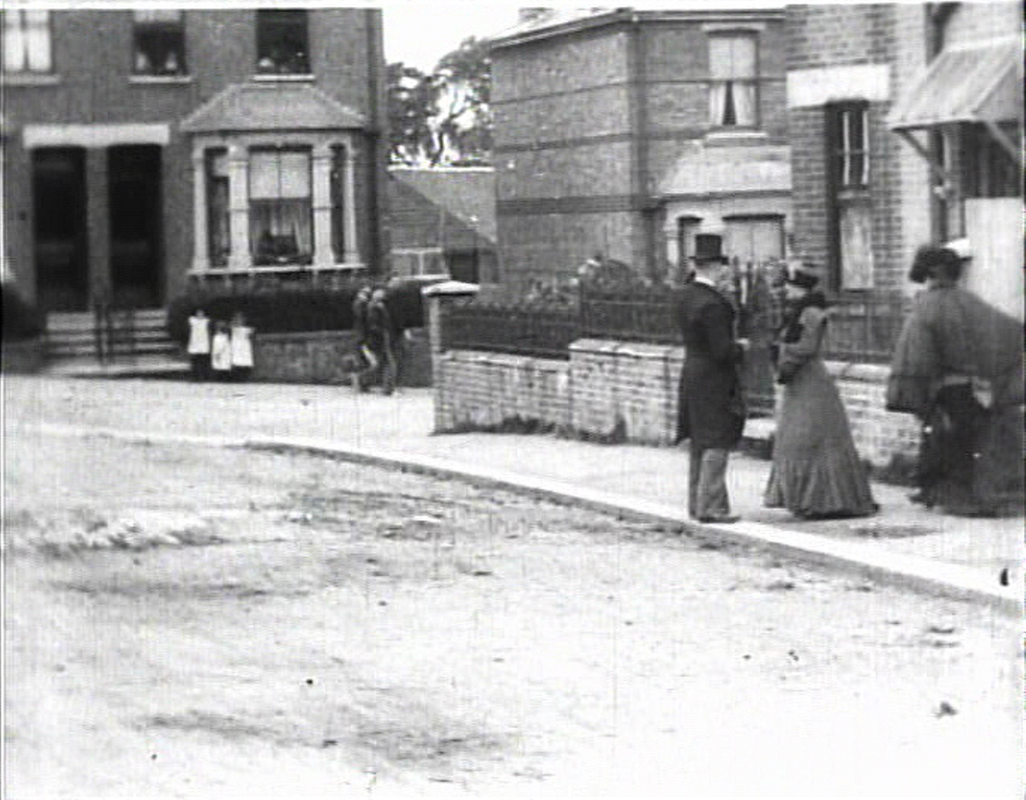
the aspect of the place, very little changed, except that the bay window of number 141 has gone (I didn’t think the outward appearance of a house could be undone in that way), the shrubbery has burgeoned (in this photograph it hides where the bay window was), and the railings of the house on Newton Avenue have gone too (was that because of a war?).
One:
the aspect of the place, very little changed, except that the bay window of number 141 has gone (I didn’t think the outward appearance of a house could be undone in that way), the shrubbery has burgeoned (in this photograph it hides where the bay window was), and the railings of the house on Newton Avenue have gone too (was that because of a war?).
|
|
Two:
the passers-by. We can count at least six professional actors in the film: the man who is run over; the woman he was talking to and with whom he runs off at the end; the policeman; the man who pronounces the victim dead (a doctor); the cab driver; and the cab driver’s passenger. (The woman who comes down Newton Avenue and passes by the victim and friend is almost certainly a member of the cast, since she or someone like her appears in the same hat and cloak in Paul's 1905 film The Unfortunate Policeman.) But there are at least twenty, possibly up to twenty-five, passers-by in the film. Some of them pass ignoring the action but most either turn or stop to look. In particular there are, in shot one, three little girls, of different size but in identical garb, standing in front of number 139, apparently transfixed by the action:
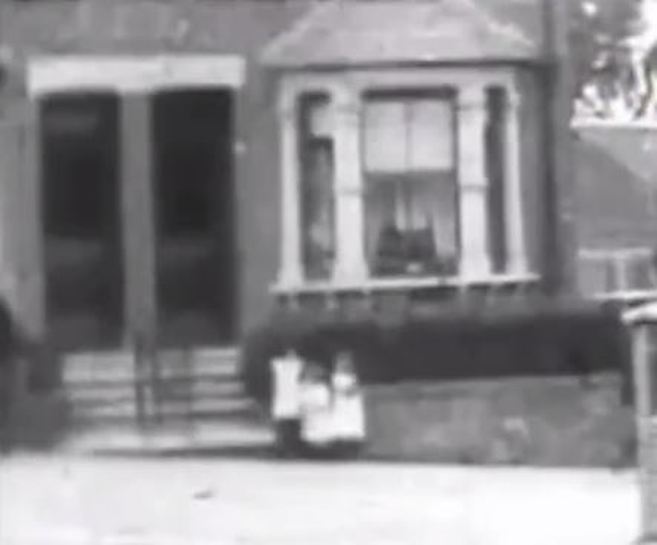
In shot two, where there is a larger gathering in which I cannot make out all three girls, one of them at least has been bold enough to run forward for a better view of the action. By the time shot three is taken they seem to have been gathered by an adult, along with a boy or two, and are watching more quietly. I would like to know about those girls: to know what they saw, how often they saw such things, and what they thought about such things happening on their doorstep. They are a different kind of ordinary person from the man or woman who, in street-filmed local cinema, reacts to the camera with a tip of the hat or embarrassed smile, acknowledging that they are a part of the spectacle. These girls were watching a spectacle that excluded them, but of which they are now, by chance, necessarily a part.
|
Three:
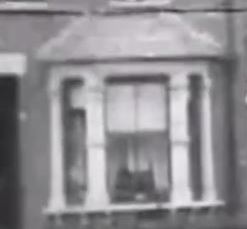
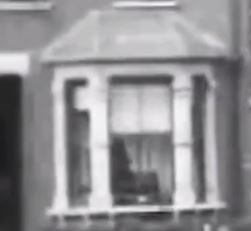
the woman in the window. I don’t know that she is a woman, but there is someone, and I’ll imagine it’s a she, in the ground floor front of number 139 who, by the time shot three is being taken, has had her attention drawn by the activities in the street outside. At the beginning of the shot we see her curtain drop to the left, as if she had looked quickly and then thought she wouldn’t, or shouldn’t. And then she pulls it back again, to keep it open for the rest of the film, she too transfixed by the spectacle. That unknown, unseen spectator, with her other look (a fifth look that film theory hasn’t yet mentioned), is like us, almost. She is looking askew at the fiction, from the wrong angle. We see it right, but are looking around and beyond it, at the place in which the fiction happens, the space in which we see her, almost. |
|
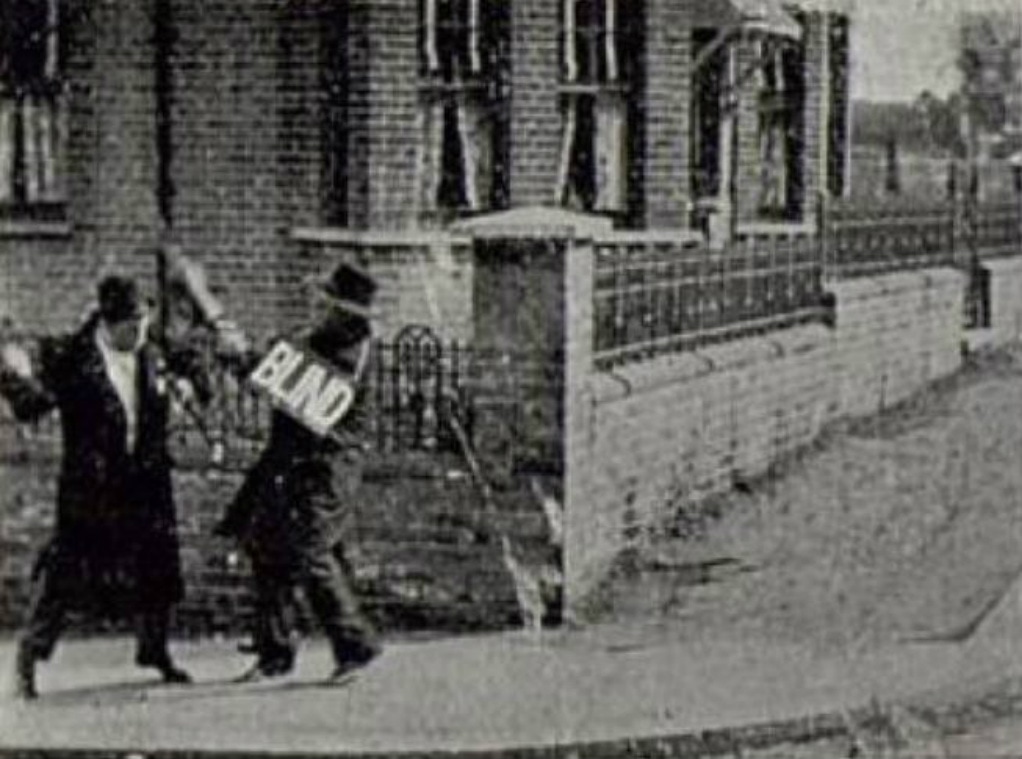
Of a film we cannot see at all, because it survives now only as a catalogue description and one still image, she would have got a much better view. When Paul's film Blind Man's Bluff was being shot (perhaps a year or two later), looking out of her window she would have clearly seen a man give a coin to a 'crippled, blind' beggar and the fight that ensued when the man discovered that the beggar was in no way infirm. This scene was played out on the same street corner as An Extraordinary Cab Accident, only shot from the reverse angle, her angle:
The other six local films that survive are topographically more complex, combining location shooting and studio confections. Some of their locations can be identified:
- Buy Your Own Cherries (1904): the Palace Tavern, at the top of Alexandra Road (possibly).
- Mr Pecksniff Fetches the Doctor (1904): Colney Hatch Lane, outside Paul's new house at 194.
- The Unfortunate Policeman (1905): Wetherill Road; Colney Hatch Lane (as in Mr Pecksniff Fetches the Doctor).
- Is Spiritualism a Fraud? (1906) : Newton Avenue; Sydney Road, Wetherill Road.
- The ? Motorist (1906): the Orange Tree at Friern Barnet; Sydney Road.
- The Fatal Hand (1907): Pembroke Road; Muswell Hill railway station.
Among the films listed in Paul's catalogues that have not survived, several can be seen from the descriptions or the accompanying illustrations to have been shot locally:
- A Little Bit of Cloth: Colney Hatch Lane
- Blind Man's Bluff: Pembroke Road/Newton Avenue
- Bill Sikes Up-To-Date: Alma Road
- Novel Airship (William Beedle's ascent, possibly 03.11.1903): Alexandra Palace
- The Ascent of the Barton-Rawson Airship: Alexandra Palace
- Brown's Fishing Excursion: the boating lake in Alexandra Park (pure conjecture)
- The London Express: railway line between Wood Green and New Southgate
- Barnet Fair: the Horse Fair and the Pleasure Fair
- High Diving at Highgate: Highgate Ponds, Parliament Hill Fields
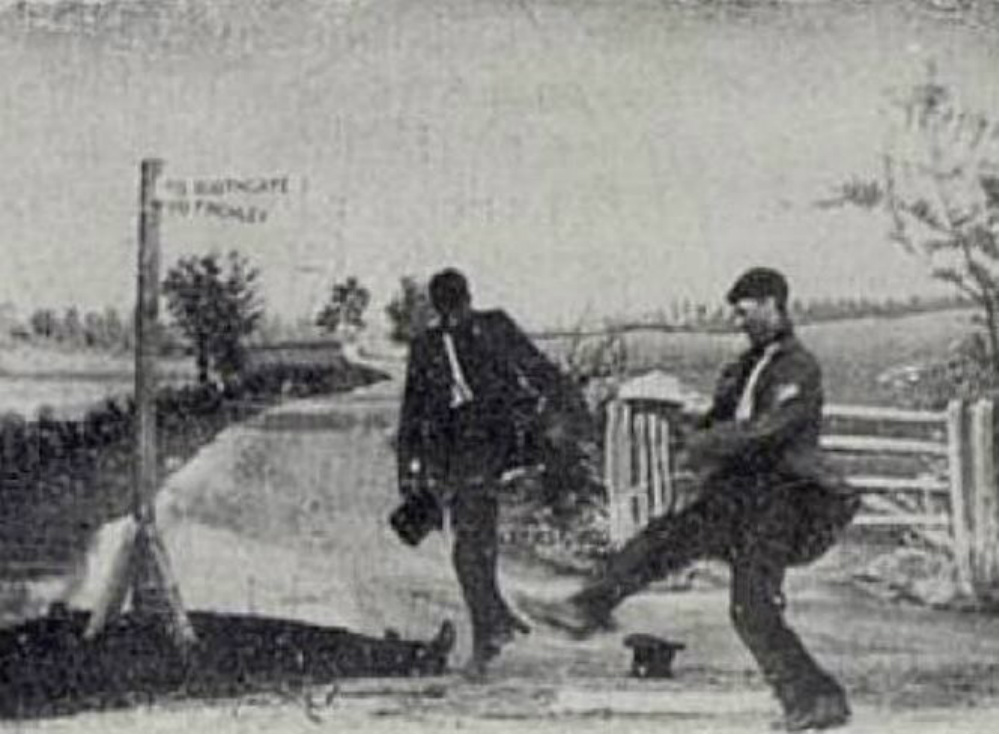
The Fakir and the Footpads
In this still from the lost film The Fakir and the Footpads, a signpost on what the 1907 catalogue describes as 'a country lane' points to Southgate and Finchley.
For Robert Paul's speech to the British Kinematograph Society in 1936, see here.
To see the collected extant films of Robert Paul, buy Ian Christie's wonderful edition for the BFI, with illuminating notes: R W Paul: the Collected Films 1895-1908
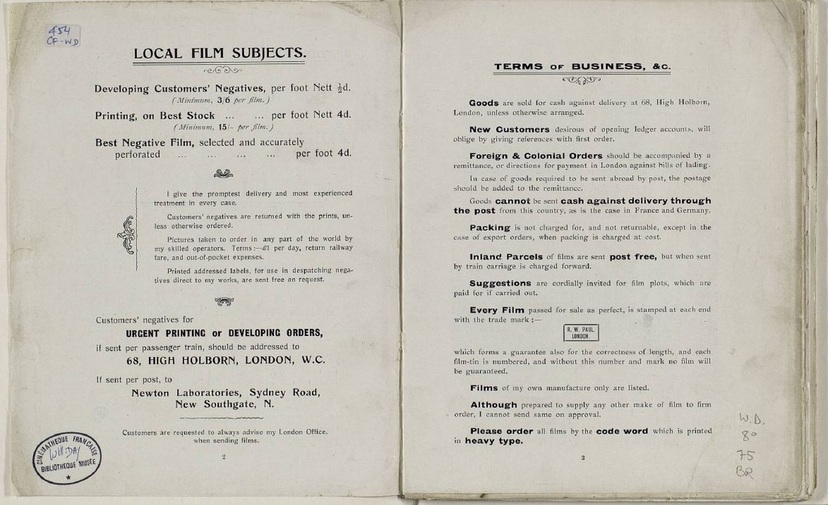
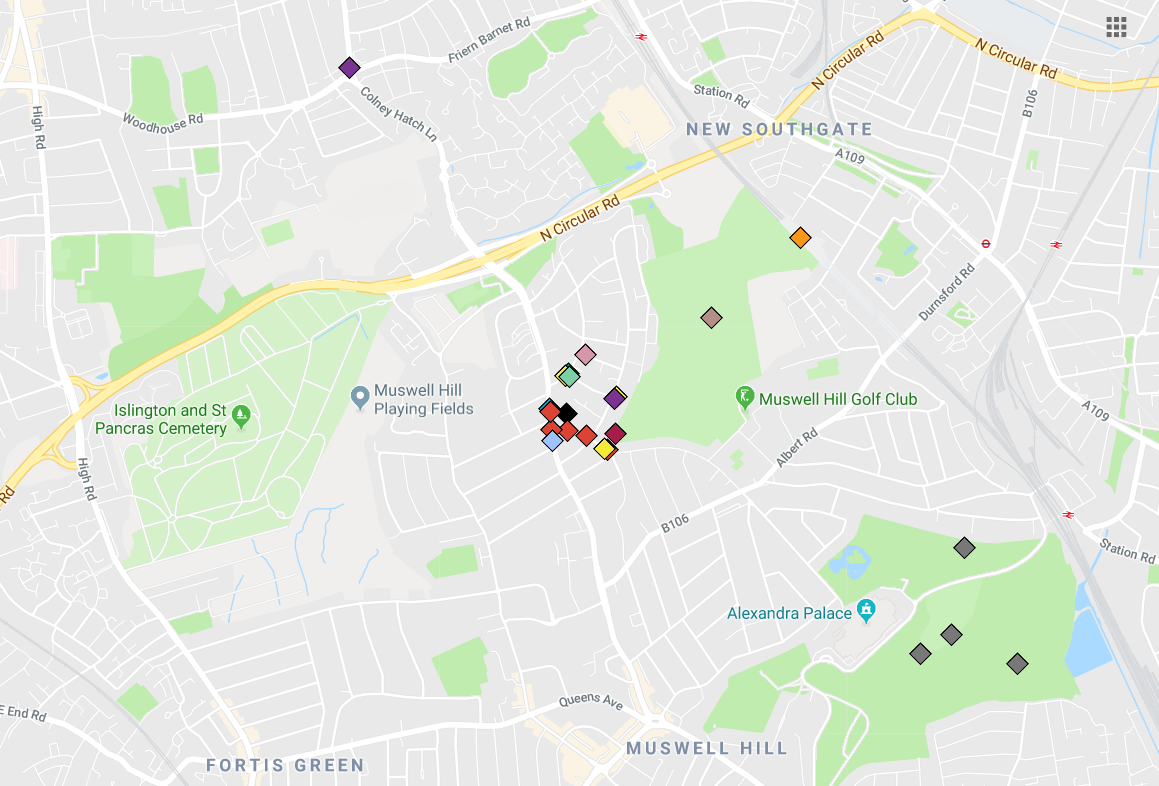
Below is a Google Map of locations in R.W. Paul films:
(all 'today' photographs are from Google Street View, apart from that of the plaque on Robert Paul's house, taken by me)
Robert Paul in the Who's Who of Victorian Cinema: here
Robert Paul in the Who's Who of Victorian Cinema: here