Alice Guy's lost brothel films
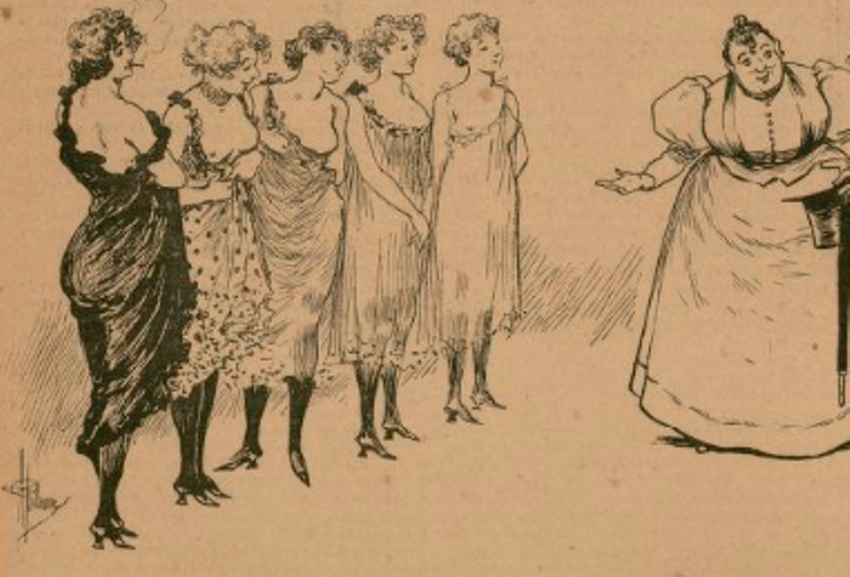
An often-quoted passage of Alice Guy's memoirs gives specific examples of sources for the inspiration behind some of her films:
|
|
At that time, we were not much concerned with copyright and sought inspiration from everywhere. Personally I found it in:
- Grand Guignol plays for: Asile de nuit, Le Paralytique, Lui, Au télephone; - drawings by Guillaume for: Amoureux transis, Professeur de langues vivantes (about this film Gaumont asked me sternly how I came to be familiar with that milieu), La Fève enchantée; - theatre, legends and novels for: Lèvres closes, La Légende de Saint Nicolas, Conscience de prêtre. |
It is almost certain that none of the films referred to above survives, but identifying the sources more specifically can give us a sense of what they were like. In some cases Guy seems to have given the name of the source text as opposed to the film derived therefrom. Of these titles only Conscience de prêtre and Lèvres closes appear in Frédérique Moreau's 1986 filmography of Gaumont fictions (in Gaumont: 90 ans de cinéma), though I am sure that his Conte de Saint Nicolas corresponds to Guy's Légende de Saint Nicolas. All three are dated 1905 by Moreau.
More recently, Maurice Gianati ('Alice Guy a-t-elle existé?', 2012) has attempted to identify the films Guy mentions with other titles in the Gaumont catalogues, arriving at these conclusions:
Amoureux transis = Gage d'amour (1904)
Professeur de langues vivantes = Le Lorgnon accusateur (1905)
Le Paralytique = Lèvres closes (1906)
Au téléphone or Lui = L'Assassin (1907)
Oddly, he mistranscribes Guy's La Légende de Saint Nicolas as La Liqueur de Saint Nicolas, which he then identifies with Le Conte de Saint Nicolas (dated as 1906). There are other oddities in Gianati's account. Drawing on his own collection of catalogues, he probably has good reason for giving different dates from Moreau for Le Conte de Saint Nicolas and Lèvres closes, but his explanation for why Guy lists Le Paralytique and Lèvres closes as two different films when for him they are one and the same would probably be his usual reference to her confused memory.
Amoureux transis = Gage d'amour (1904)
Professeur de langues vivantes = Le Lorgnon accusateur (1905)
Le Paralytique = Lèvres closes (1906)
Au téléphone or Lui = L'Assassin (1907)
Oddly, he mistranscribes Guy's La Légende de Saint Nicolas as La Liqueur de Saint Nicolas, which he then identifies with Le Conte de Saint Nicolas (dated as 1906). There are other oddities in Gianati's account. Drawing on his own collection of catalogues, he probably has good reason for giving different dates from Moreau for Le Conte de Saint Nicolas and Lèvres closes, but his explanation for why Guy lists Le Paralytique and Lèvres closes as two different films when for him they are one and the same would probably be his usual reference to her confused memory.
|
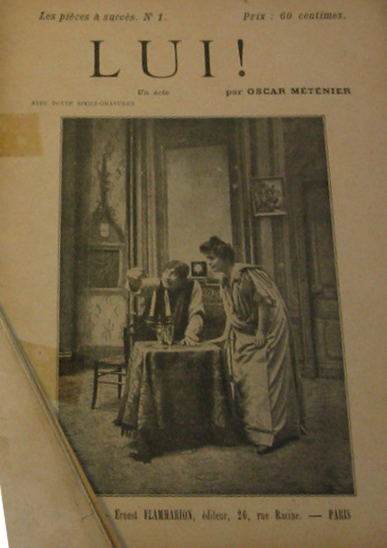
I grant that there are, at times, inconsistencies in her reminiscences that come from remembering in the 1930s and '40s things that happened c. 1900, but there are inconsistencies also in Gianati's account of things that don't have that excuse and which need pointing out. For example, he suggests that the 1907 film L'Assassin could be derived from either Oscar Métenier's Lui! (1897) or André de Lorde's Au téléphone (1901) even though the plots of those two plays are very different. Both feature assassins, it is true, but if Gianati doesn't know which assassin from those plays best corresponds to the assassin in the film, that would seem to suggest that he doesn't know the plot of the film, in which case his identification of it with either source text is shaky.
|
|
However, the Bibliothèque nationale has the scenario for a 1906 Gaumont film called L'Assassin de la vieille femme, on the basis of which we might make a surer identification. I haven't seen the document yet but the catalogue appears to list as alternative titles 'L'Assassin est connu', 'Le Crime du garçon boucher' and 'Arrestation imminente'. All of these are fitting titles for an adaptation of Métenier's Lui!, as we can see in this passage from a recent translation of the play:
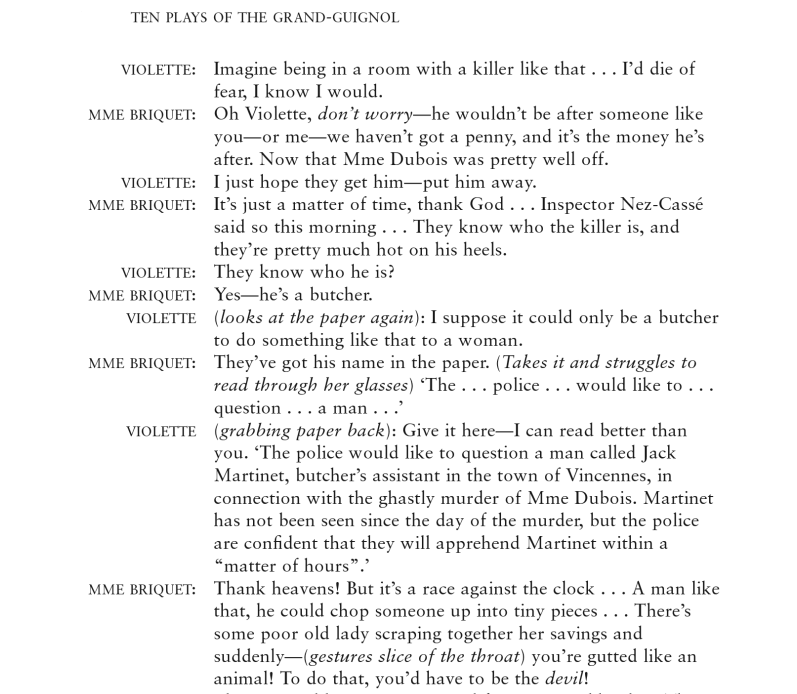
It seems to me likely, then, that one of the films Guy derived from the Grand Guignol was L'Assassin de la vieille femme. None of the surviving films attributed to her is as suspenseful as this film must have been, and we can only regret its loss. Likewise for her film of André de Lorde's Au téléphone, though here the greater interest would lie in how it compared with other films inspired by De Lorde's play, including Terrible Angoisse (Pathé 1906), Le Médecin du château (Pathé 1908), The Lonely Villa (Griffith for Biograph 1909) and of course Suspense (1913), by the woman who got started in films working for Guy, Lois Weber. (See here for a discussion of Le Médecin du château and some images from those other films related to De Lorde's play.)
Asile de nuit (1904), one of the other plays Guy credits as inspiration, is by Grand Guignol director Max Maurey, though it is more of a comedy rather than a sensational melodrama. Gianati forgets to include it in his list of films that Guy credits to herself, so doesn't suggest an alternative title for it.
I haven't found a Grand Guignol play called Le Paralytique, so cannot say if Gianati's matching of that title to Lèvres closes is feasible. A novel by Daniel Lesueur - pseudonym of the feminist author Jeanne Lapauze - called Lèvres closes was serialised in 1898. This psychological novel of passionate adultery would make an effective sentimental melodrama, but I have no means of knowing if its plot matches that of the 1906 Gaumont film of the same name. There is certainly no one who is paralysed in Lesueur's novel to justify Gianati's identification of Le Paralytique and Lèvres closes.
I haven't found a Grand Guignol play called Le Paralytique, so cannot say if Gianati's matching of that title to Lèvres closes is feasible. A novel by Daniel Lesueur - pseudonym of the feminist author Jeanne Lapauze - called Lèvres closes was serialised in 1898. This psychological novel of passionate adultery would make an effective sentimental melodrama, but I have no means of knowing if its plot matches that of the 1906 Gaumont film of the same name. There is certainly no one who is paralysed in Lesueur's novel to justify Gianati's identification of Le Paralytique and Lèvres closes.
Update February 2020:
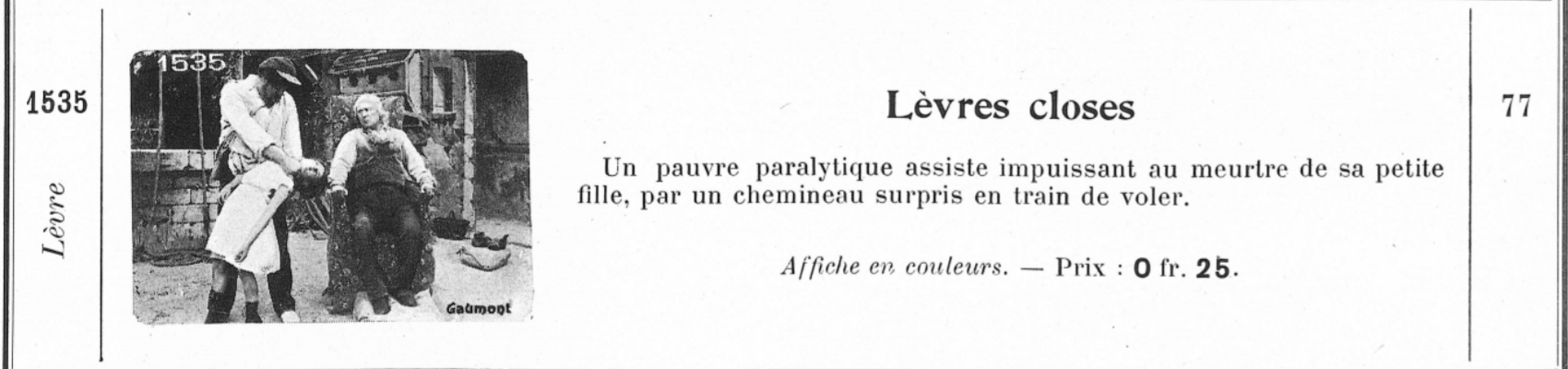
I have now seen the catalogue entry for Lèvres closes and can see exactly why Gianati identifies the film with Le Paralytique:
I have now seen the catalogue entry for Lèvres closes and can see exactly why Gianati identifies the film with Le Paralytique:
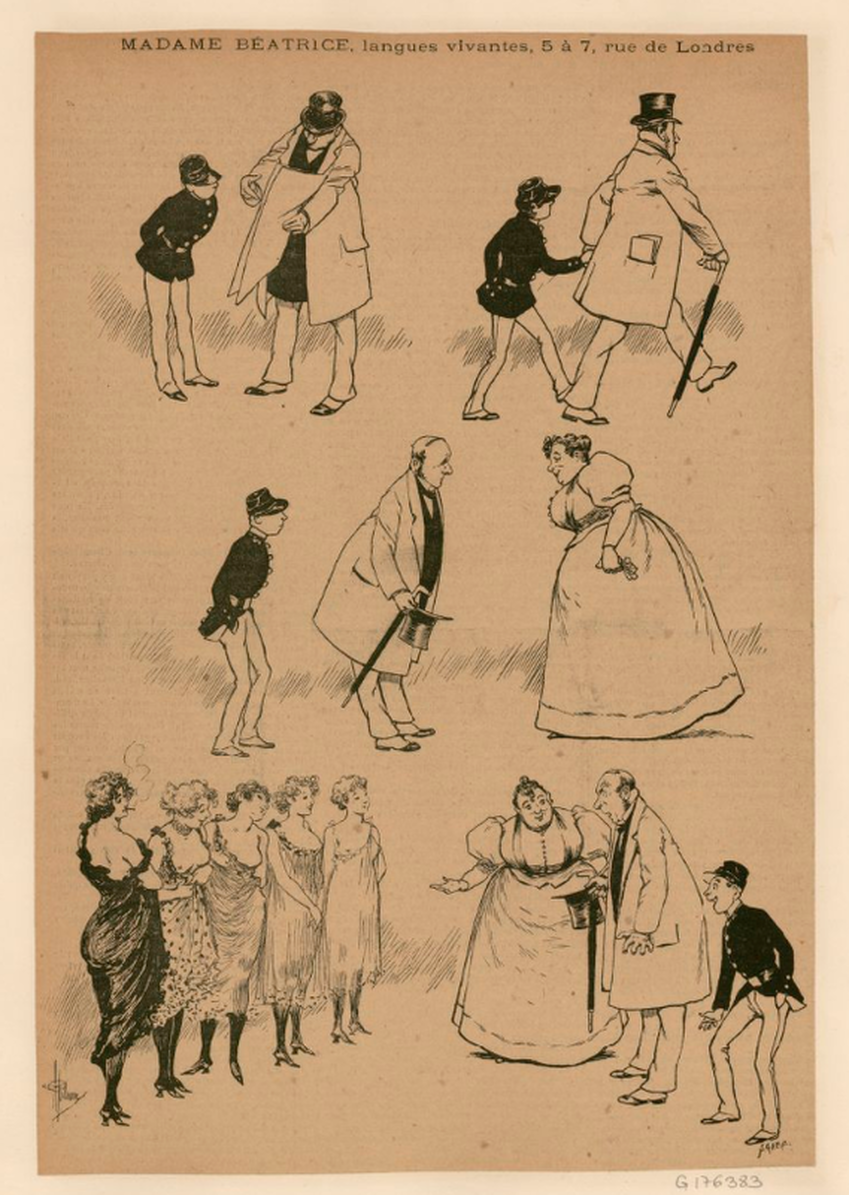
To return to L'Assassin de la vieille femme. If the film still existed, and if it were based on the play Lui!, and if it were by Guy, I would be particularly interested to see how Guy arranged the setting, which is a brothel. The female characters are the madam who runs it and a prostitute who works there, and the drama develops when the butchering murderer turns up. This brothel film would make a nice pairing with another of the films listed by Guy, Professeur de langues vivantes, which she says is based on a comic strip by Albert Guillaume. That strip was part of a series published in 1893 as Les Bonshommes:
Source: gallica.bnf.fr
The gag in Guillaume's strip is that the older man doesn't realise that an advertisement for Madame Beatrice's school of modern languages is in fact advertising a brothel. When he and his son get there all becomes clear.
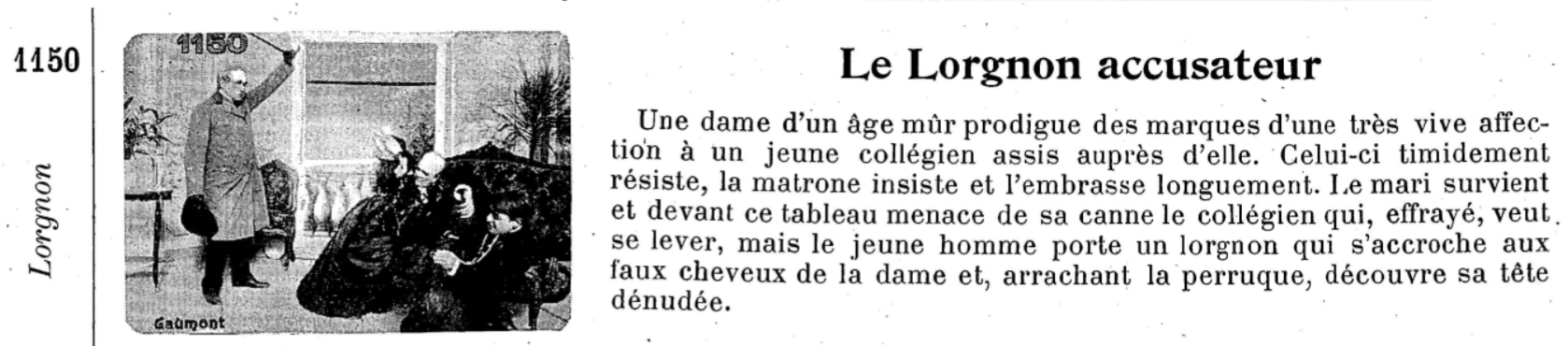
Gianati signals this source but identifies the film that Guy derived from it as Le Lorgnon accusateur, 'the accusing monocle'. This is bizarre, and suggests that Gianati didn't look at the source before making the identification because if he had he would have seen that there are no accusations and no monocles in Guillaume's comic strip.
Here is the 1908 catalogue entry for Le Lorgnon accusateur:
Gianati signals this source but identifies the film that Guy derived from it as Le Lorgnon accusateur, 'the accusing monocle'. This is bizarre, and suggests that Gianati didn't look at the source before making the identification because if he had he would have seen that there are no accusations and no monocles in Guillaume's comic strip.
Here is the 1908 catalogue entry for Le Lorgnon accusateur:
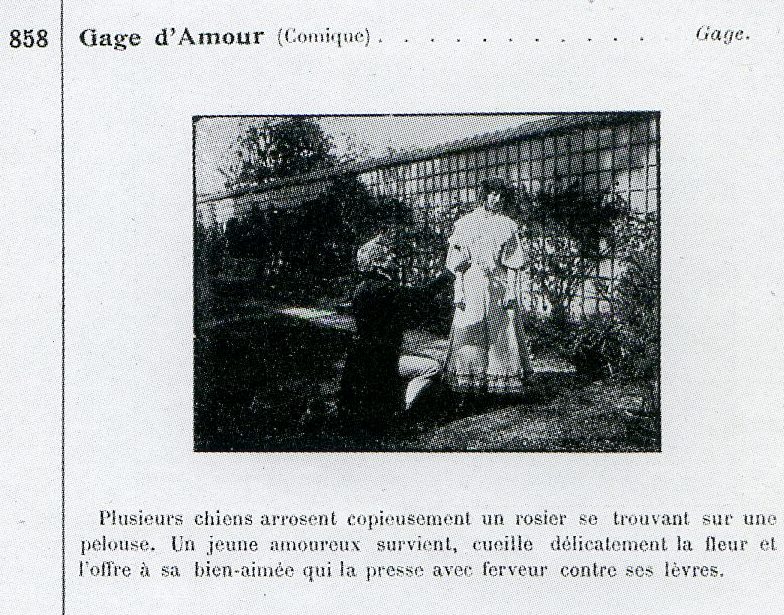
I an equally perplexed by Gianati's identification of Guy's Amoureux transis with Gage d'amour. Unless he is drawing on evidence that I don't have - and of course that is quite likely, given his vast collection of Gaumont-related materials - I can't see that a film called 'amoureux transis', bashful lovers, can be the same as one in which, to quote the catalogue Gianati reproduces: 'several dogs urinate copiously on a rose bush on a lawn. A young lover arrives, delicately picks the flower and offers it to his beloved who presses it fervently to her lips':
For reasons I still can't fathom Gianati is hostile to Alice Guy, giving the ridiculous title 'Alice Guy a-t-elle existé' to a lecture and chapter in which he insistently questions her claims regarding her role in the history of early cinema - his views have been forcefully challenged by many, including her descendant Alice Guy Jr (see here, search for Gianati) and the brilliant blogger at plateau Hassard.
Despite the rich resources he might draw on, Gianati cannot be relied on to contribute positively to our knowledge of Guy's work at Gaumont. In the vanguard of those now making such a contribution is Pamela Green with her film on Alice Guy, Be Natural.
Despite the rich resources he might draw on, Gianati cannot be relied on to contribute positively to our knowledge of Guy's work at Gaumont. In the vanguard of those now making such a contribution is Pamela Green with her film on Alice Guy, Be Natural.

references
- Maurice Gianati, 'Alice Guy a-t-elle existé?', in Maurice Gianati and Laurent Mannoni (eds), Alice Guy, Léon Gaumont et les débuts du film sonore (New Barnet: John Libbey, 2012)
- Frédérique Moreau, 'Filmographie Gaumont: Films de fiction 1896-1986', in Philippe d'Hugues and Dominique Muller (eds), Gaumont: 90 ans de cinéma (Paris: Ramsay/La Cinémathèque française, 1986)