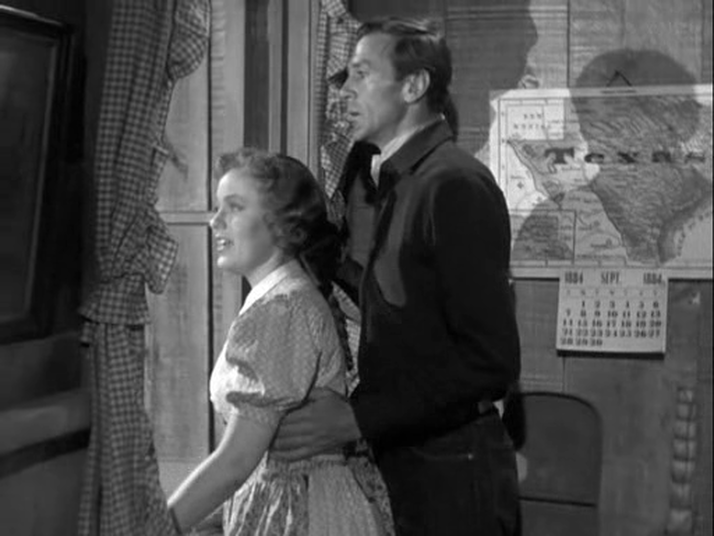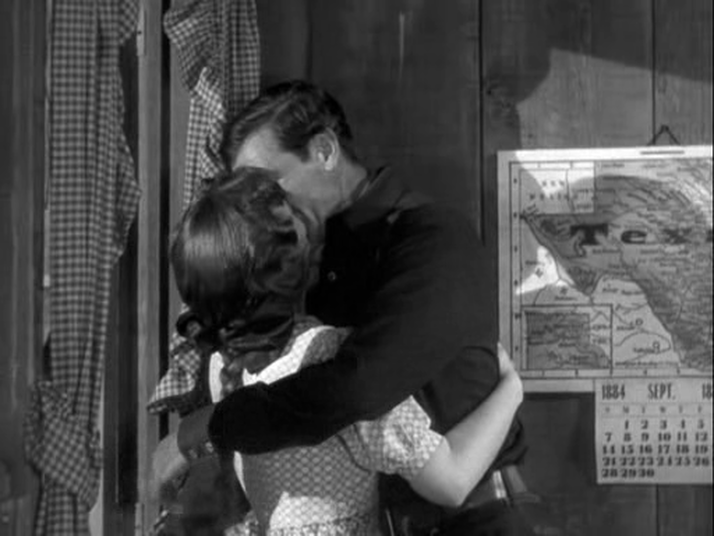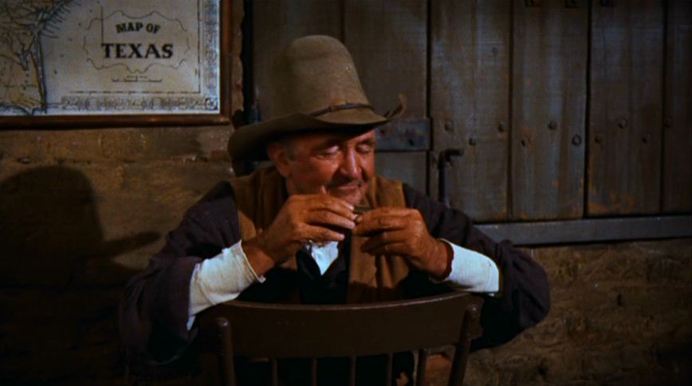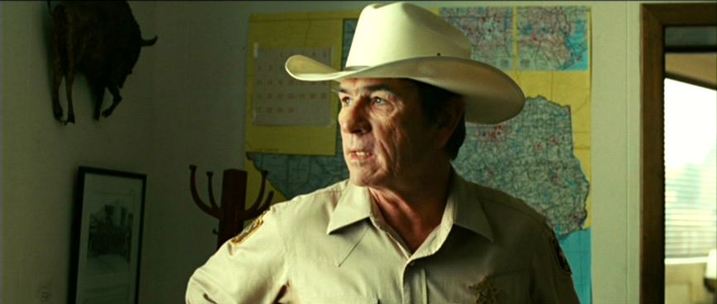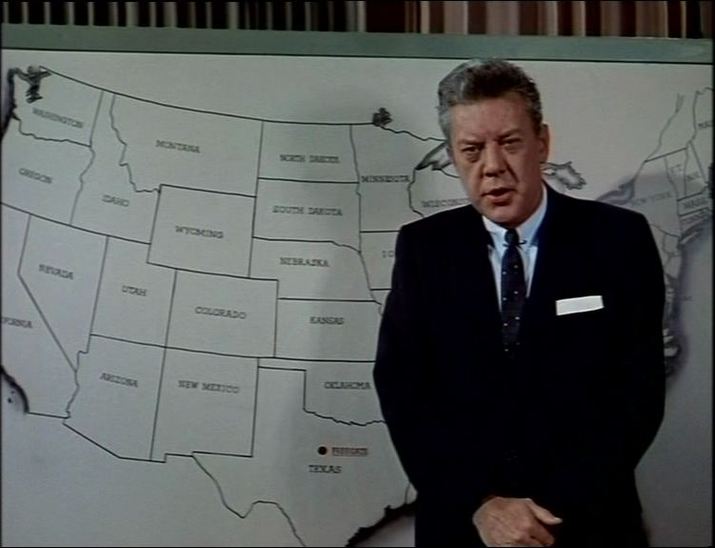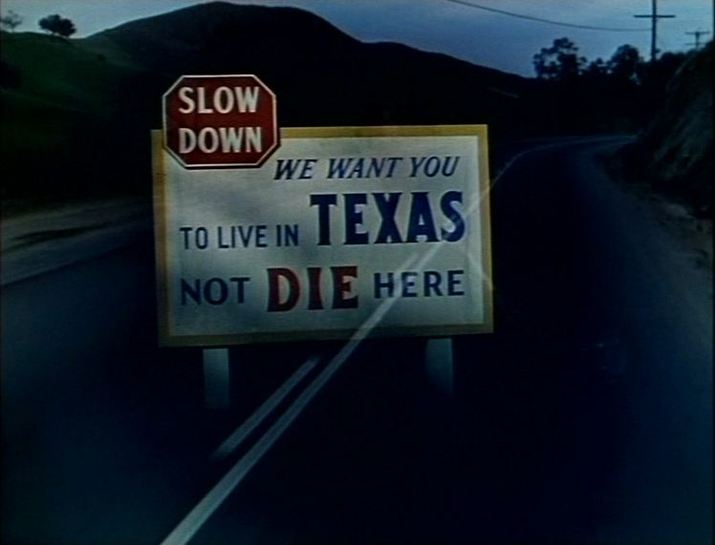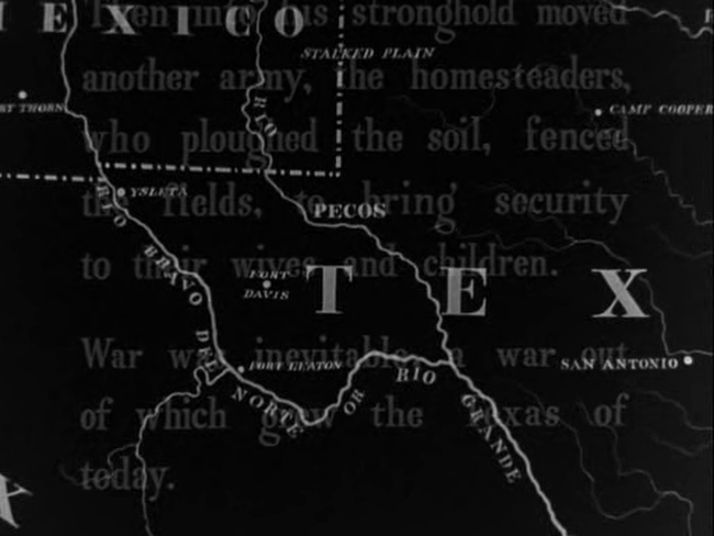
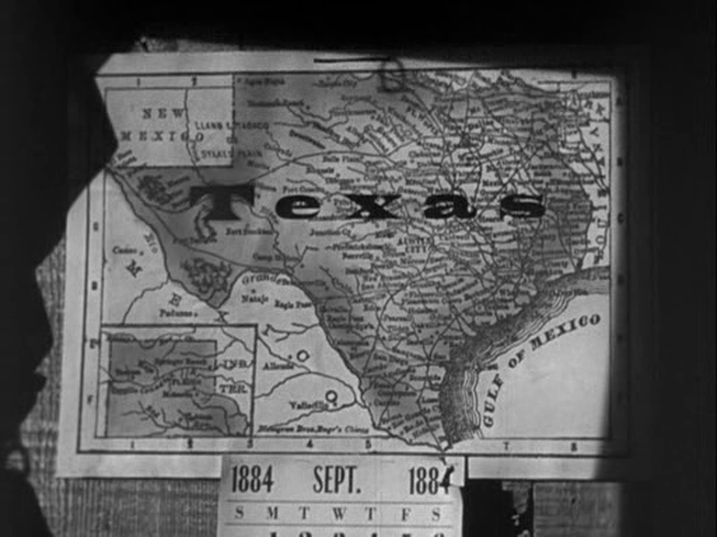
‘Let's take for example William Wyler's The Westerner. It shows very well how the territorial formation of Texas is absolutely determined by the formation of the couple. The segmentation (decoupage) in the film carries the repetition-resolution effect to an exemplary point. First shot: a map of Texas, in a fixed shot. Last shot: another map of Texas, starting from which a backward camera movement discloses the conjugal bedroom where the heroine is moving toward the window, followed by her young husband who is holding her by the waist - the wild, untamed hero whose matrimonial education is the subject of the film. The hero's fate is shaped by the feminine figure, but only to the extent that the representations organized around this figure allow for the two of them to be inscribed together in a symbolic framework.’
Raymond Bellour (with Janet Bergstrom), ‘Alternation, Segmentation, Hypnosis’, in Constance Penley (ed.), Feminism and Film Theory (London: Routledge, 1988), pp.187-88.
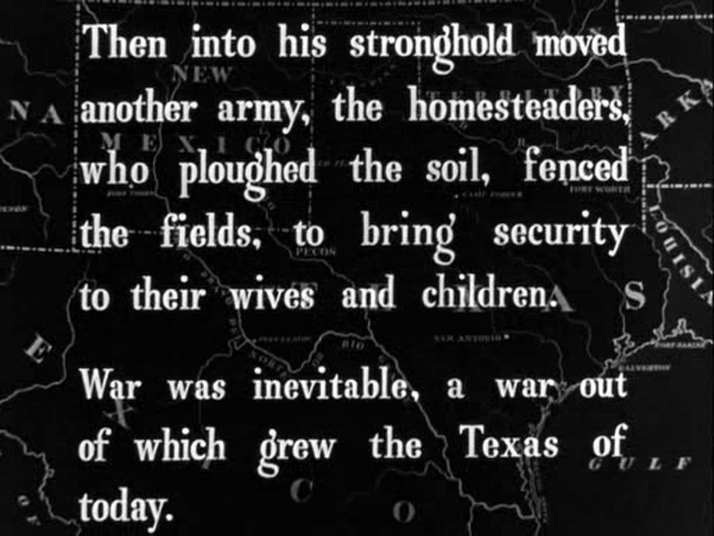
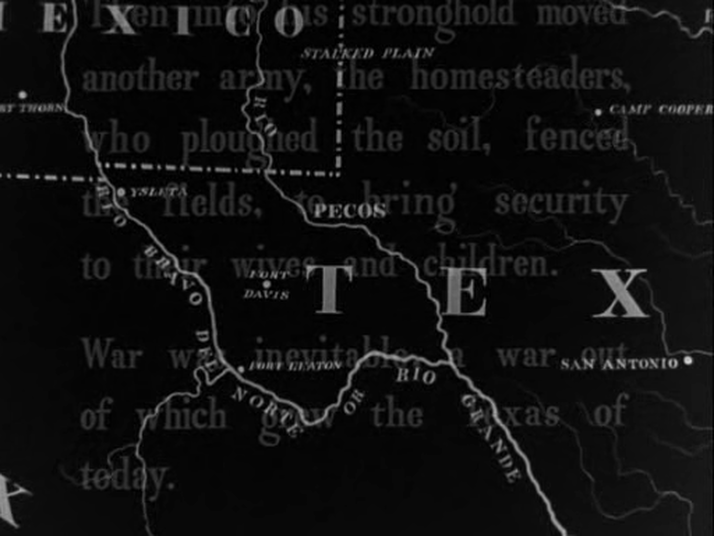
The bookending maps are opposed in several, complementary ways:
1/ The first map is outside of the narrative, an illustrative accompaniment to the narration superimposed upon it, whereas the second is inside the narrative, integral to the mise-en-scène of the last scene.
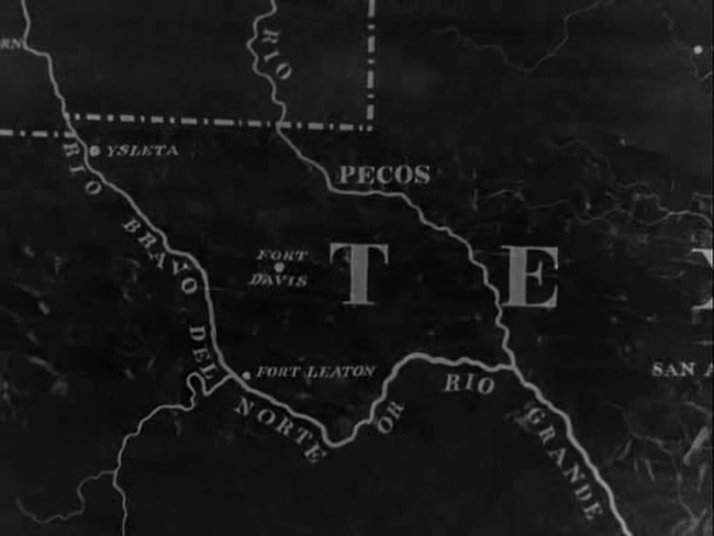
2/ The details of the first map are only partially readable, because of the superimposed narration but also because the word that names it - 'Texas' - is cut off as the camera pulls out (it is not a static shot), and also because the full outline of the state is not shown, as if the state were not yet fully formed. The second is a complete, fully readable map of Texas.
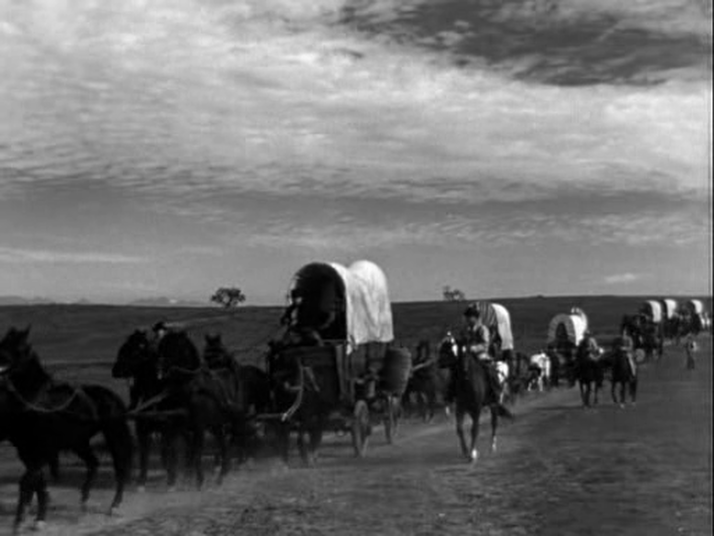
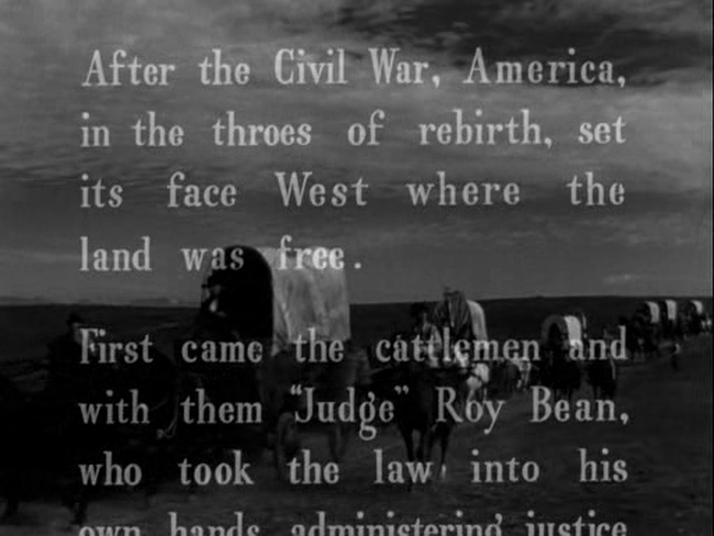
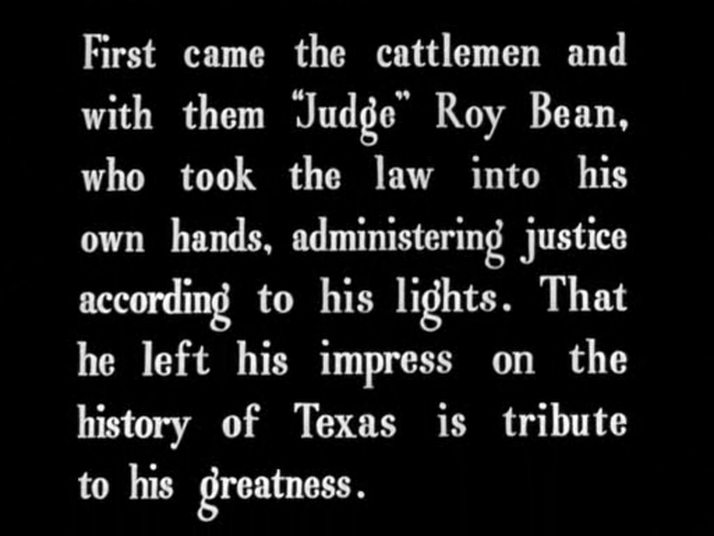
3/ Through the narration, the first map has a loose chronology associated with it: 'After the Civil War, America, in the throes of rebirth...'; 'First came the cattlemen, and with them "Judge" Roy Bean...'; 'Then into his stronghold moved another army, the homesteaders...'; 'War was inevitable, a war out of which grew the Texas of today.'
Raymond Bellour (with Janet Bergstrom), ‘Alternation, Segmentation, Hypnosis’, in Constance Penley (ed.), Feminism and Film Theory (London: Routledge, 1988), pp.187-88.
The bookending maps are opposed in several, complementary ways:
1/ The first map is outside of the narrative, an illustrative accompaniment to the narration superimposed upon it, whereas the second is inside the narrative, integral to the mise-en-scène of the last scene.
2/ The details of the first map are only partially readable, because of the superimposed narration but also because the word that names it - 'Texas' - is cut off as the camera pulls out (it is not a static shot), and also because the full outline of the state is not shown, as if the state were not yet fully formed. The second is a complete, fully readable map of Texas.
3/ Through the narration, the first map has a loose chronology associated with it: 'After the Civil War, America, in the throes of rebirth...'; 'First came the cattlemen, and with them "Judge" Roy Bean...'; 'Then into his stronghold moved another army, the homesteaders...'; 'War was inevitable, a war out of which grew the Texas of today.'
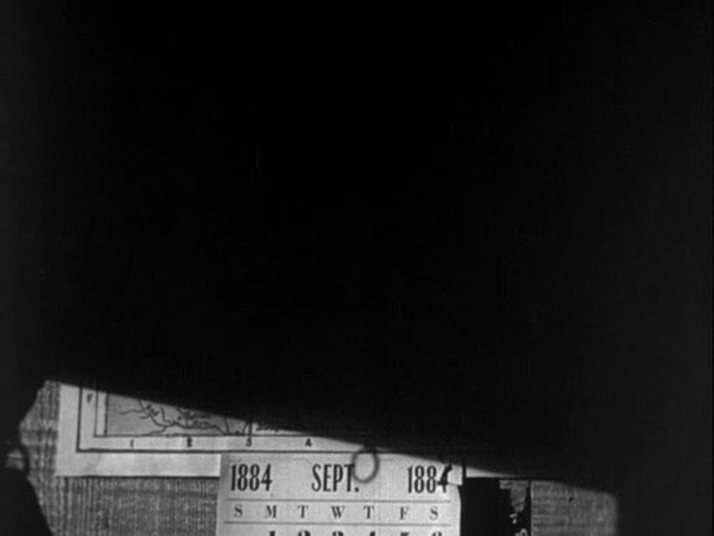
Whereas the second map has attached to it a specific date, as if precise chronology were a function of territorial formation (this is a recurrent chronotope of the Western):
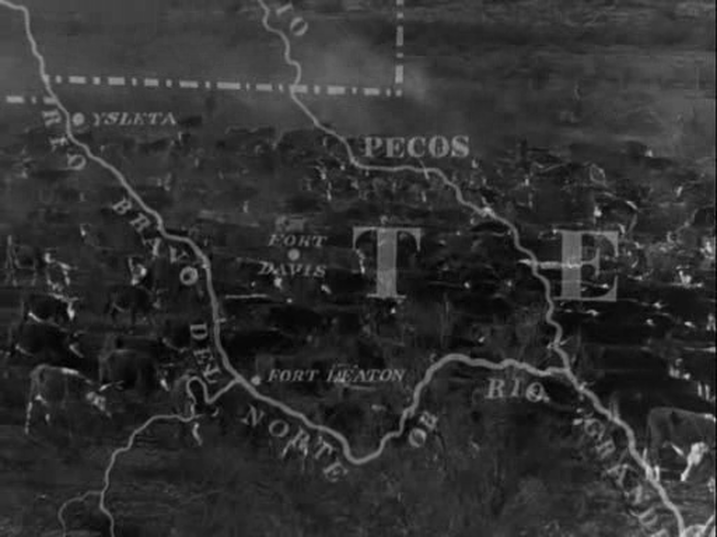
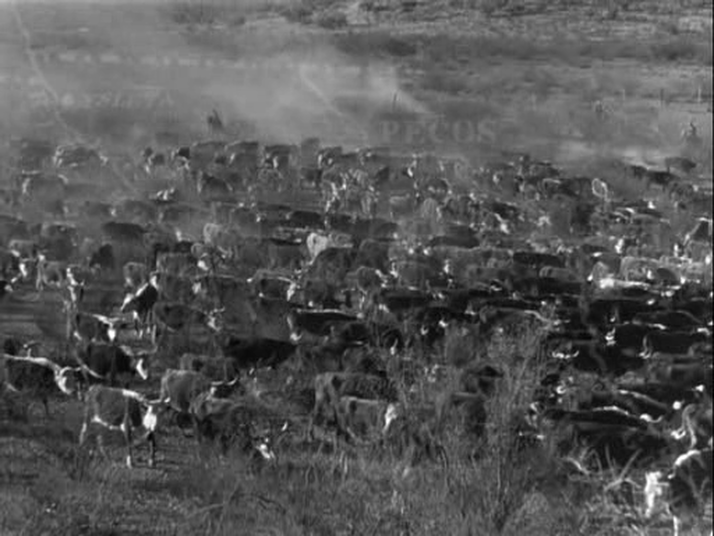
Bellour's emphasis on the hero's 'matrimonial education' plays down two other subjects of the film related to the presentation of maps. What we first see after the first map is the opposition of cattlemen and homesteaders as a story of fence-breaking and fence-making:
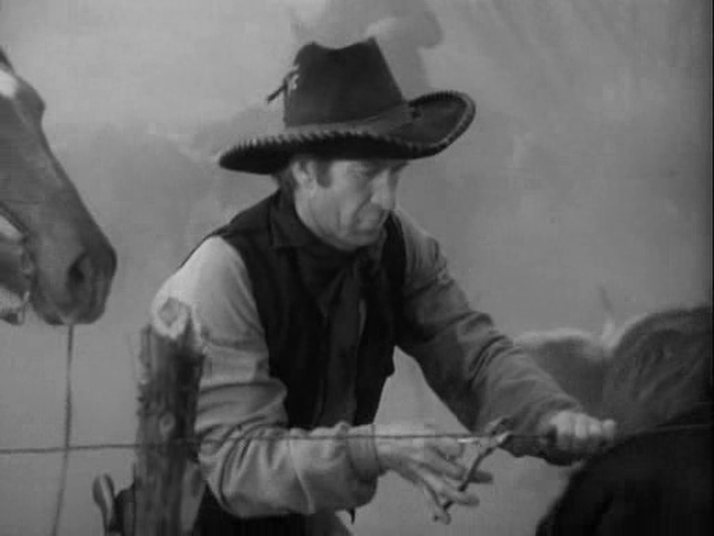
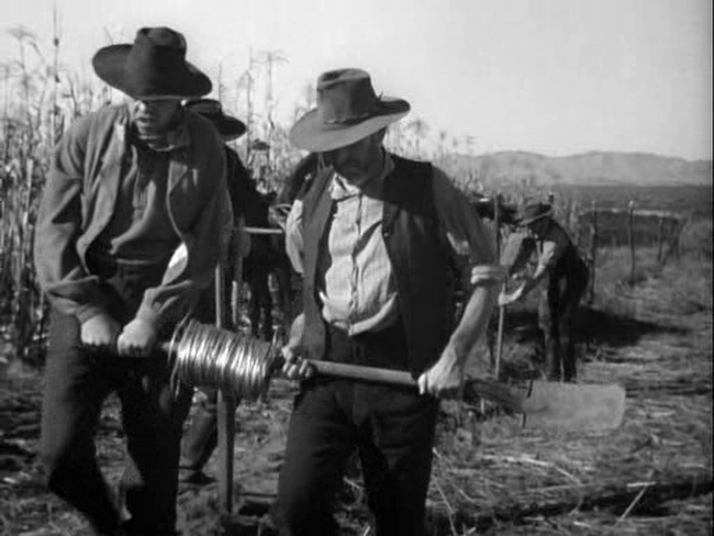
The tracing of these territorial boundaries is a cartographic practice, making possible the identification of Texas on the map that is a part of the film's resolution.
The second subject is tied to the theatrical motif. The end of Judge Roy Bean's story is the abortive performance of Lily Langtree, who is replaced on the stage by Gary Cooper ('The Westerner'), dramatically revealed as the curtain rises. The end of this sequence shows the empty theatre as the curtain comes down. We do not see it come down on the stage, only how the lighting of the scene changes as the shadow of the curtain falls:
The second subject is tied to the theatrical motif. The end of Judge Roy Bean's story is the abortive performance of Lily Langtree, who is replaced on the stage by Gary Cooper ('The Westerner'), dramatically revealed as the curtain rises. The end of this sequence shows the empty theatre as the curtain comes down. We do not see it come down on the stage, only how the lighting of the scene changes as the shadow of the curtain falls:
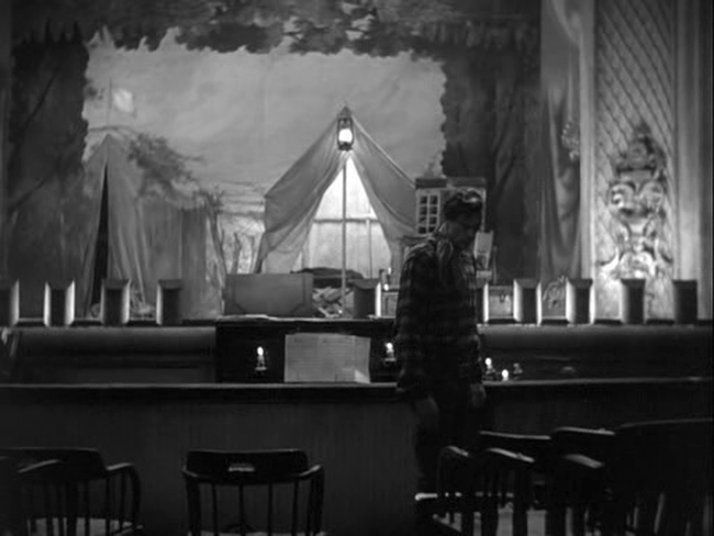
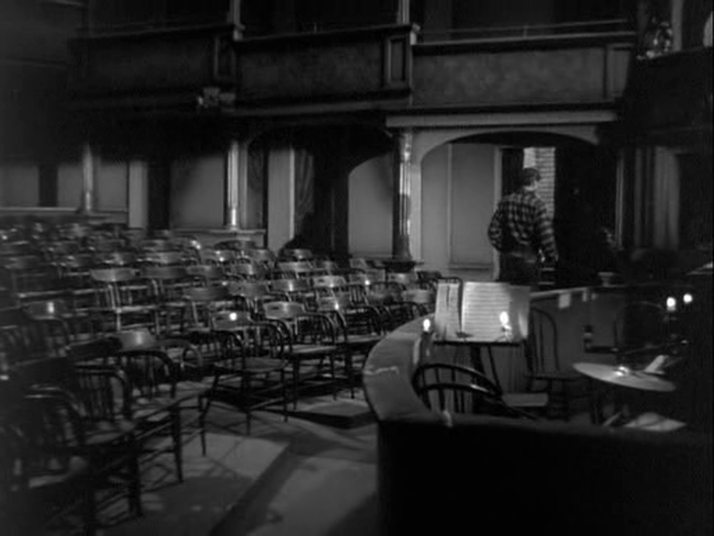
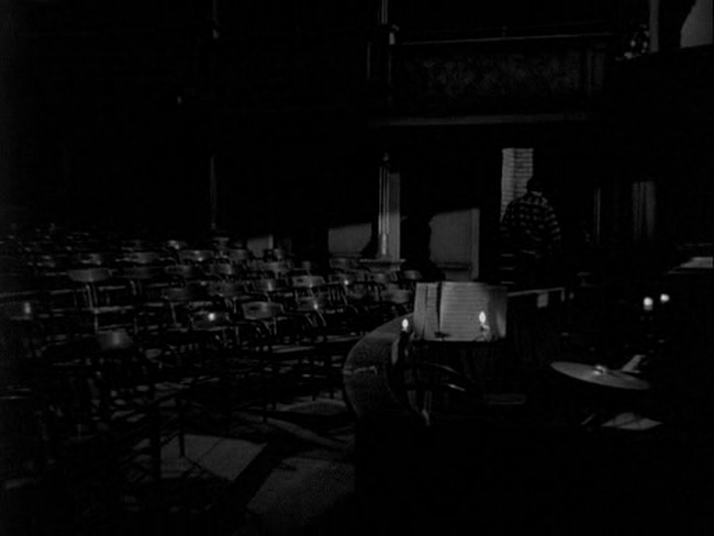
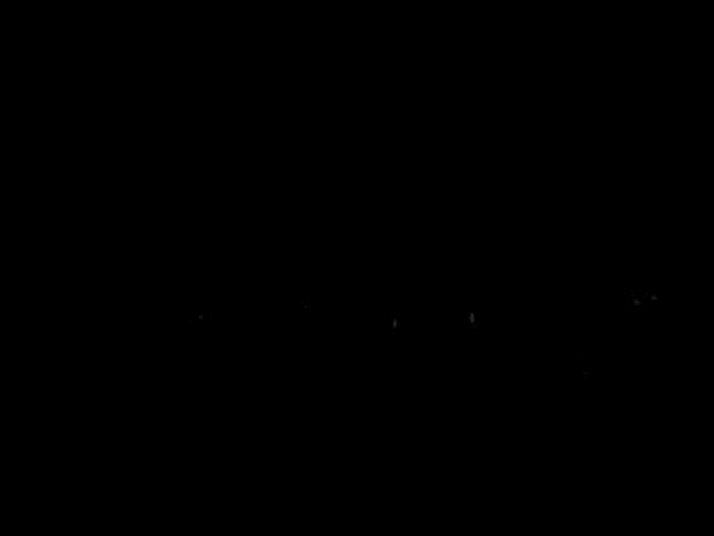
In the next sequence (some time after), this is followed by a shift in the mise-en-scène of the motif, as we see a blind rising theatrically to reveal not a stage but a map:
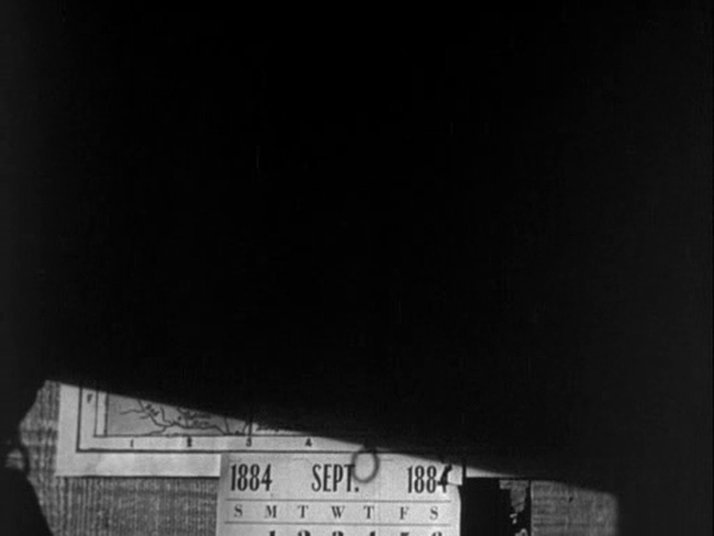
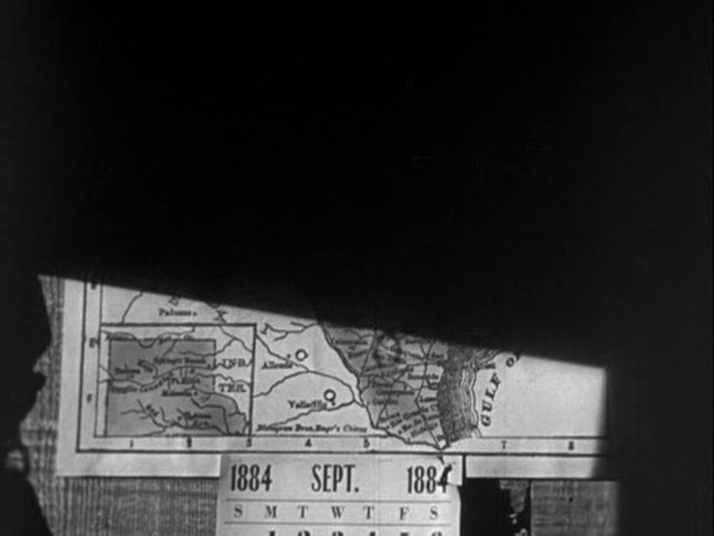
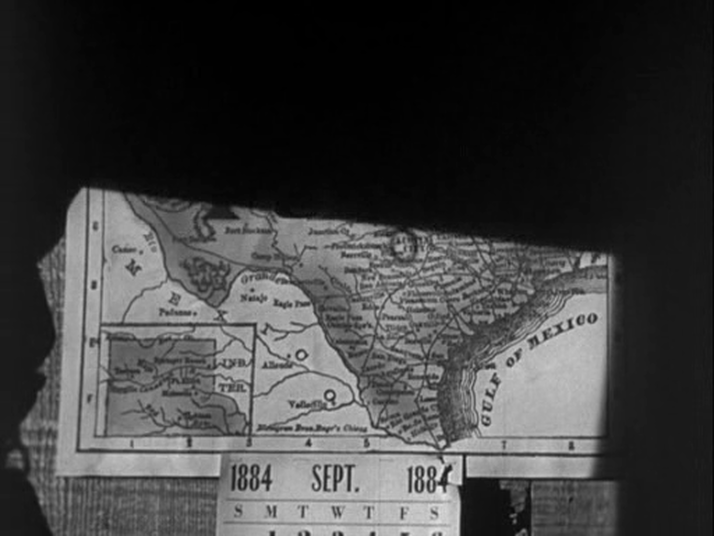
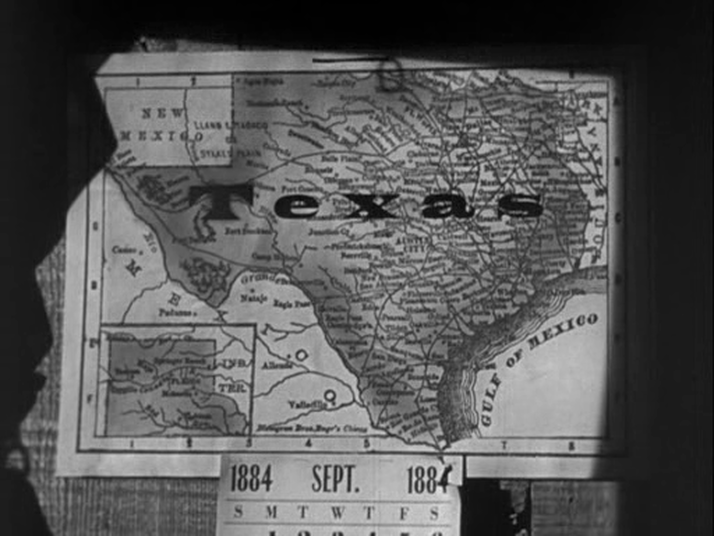
This staged effect mimics a wipe, contrasting with the actual use of editing effects in the presentation of the first map (superimposition and dissolves).
The 'stage', now, is the domestic space, the conjugal bedroom. The displacement of theatricality onto cartographic display is one of the representations around the couple that, in Bellour's words, 'allow for the two of them to be inscribed together in a symbolic framework':
The 'stage', now, is the domestic space, the conjugal bedroom. The displacement of theatricality onto cartographic display is one of the representations around the couple that, in Bellour's words, 'allow for the two of them to be inscribed together in a symbolic framework':